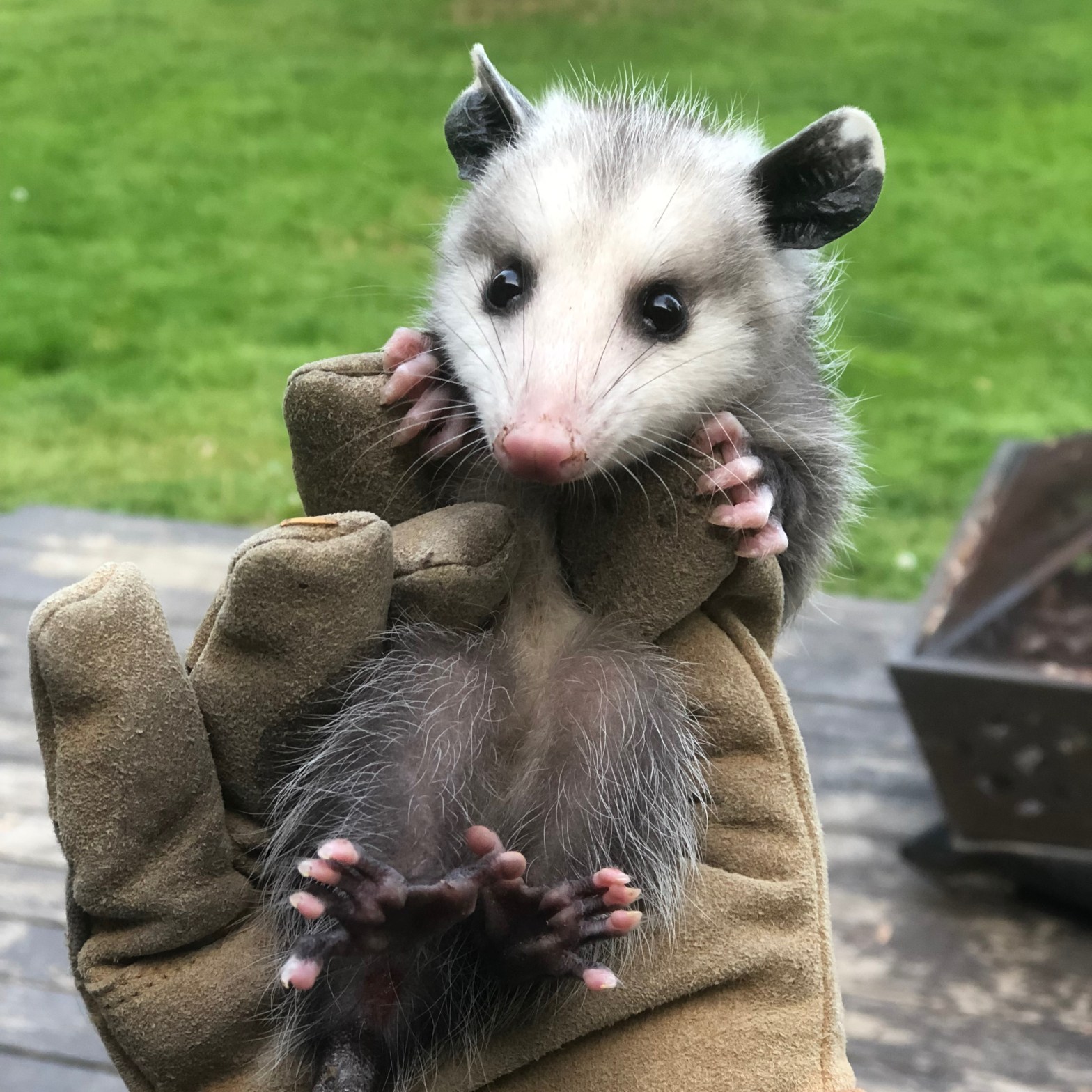
Let’s just say this: you’ve been tricked!
It’s been a fairly recent idea that opossums are the epitome of tick control. Society has gone from viewing these marsupials as disposable pests to valuing their presence around the farm as a form of natural tick removal, all in the span of about 10 years. They are so widely accepted now, in fact, that farmers and homeowners alike are even intentionally letting them roam their lands, in situations where previous generations would have merely dispatched and disposed of them.
But, where do they actually stand?
To figure out whether or not they’re actually the tick vacuums that society thinks they are, we have to take a look at where this information came from in the first place.
The Initial Experiment
You see, the idea that opossums eat ticks was actually based on a 2009 study by the Cary Institute of Ecosystem Studies that was done on opossums in captivity. The study was conducted on six different animal species – white footed mice, eastern chipmunks, grey squirrels, opossums, veeries, and catbirds – and measured their ability to remove ticks from themselves.
To simulate a tick-infested environment, the scientists placed 100 larval deer ticks on each animal’s head and neck with a number 00 paintbrush, confined them in a motion-restricting chamber for 4 hours to allow them time to attach to the body, and recorded the amount that dropped from the body over the course of 4 days. Any ticks unaccounted for were assumed to have been eaten or destroyed by the animal when grooming itself.
Out of all six species tested, the opossums had the largest tick removal rate (83-96.5%).
With that data, the scientists then used equations to predict the amount of ticks “trapped” (eliminated) by each animal within their simulated ecosystem and how that would shift the tick burden (density) between the other five commonly-infected species being tested.
Overall, it was predicted that, within that simulated ecosystem, opossums would eliminate 5,686 larval ticks.
However, these statistics haven’t held true to opossums in nature.
New Research
Many scientists and fellow researchers took interest in the Cary Institute’s findings and wanted to see how they translated to opossums in nature. This is where their data went off the rails – metaphorically speaking, of course.
A 2021 study published in Ticks and Tick-borne Diseases actually disproved the 2009 study’s predictions when they examined the stomach contents of 32 wild opossums in central Illinois. Using a microscope to look for ticks and ticks remnants, they found no signs that any of the opossums had been eating any ticks.
Furthermore, 23 additional diet analyses performed by other independent researchers – 19 performed on stomach and digestive tract contents and 4 examining scat – came to the same conclusion: none of the opossums that they had studied had been eating any ticks either.
What gives?
Where the Initial Experiment Went Wrong
The biggest scientific pitfall of the initial 2009 study was that there was no control done to eliminate non-typical behaviors caused by bringing wild animals into a laboratory setting, which they were unconditioned for and unused to. In other words, animals that were initially wild were suddenly caged and put under extreme duress. Any major change such as this can intensely affect their behavior, even causing excess grooming that doesn’t typically occur in nature.
Another major pitfall was the fact that the study only focused on how effective each species was as a host. Only the ticks that dropped off the body after 4 days were assumed to be “effectively hosted” and recorded, however this didn’t account for a large portion of the originally introduced ticks that could have still been remaining on the body. Instead, it was assumed that any ticks unaccounted for after 4 days were groomed away by the animal and destroyed. Since ticks can feast for up to 6 days before dropping off, the initial study leaves two entire days’ worth of live ticks unaccounted for. This major discrepancy creates a huge scientific gap to debate whether or not any of the study’s findings could even be considered accurate in the first place.
Essentially, the researchers had taken wild animals, put them in unfamiliar situations of extreme stress, used the resulting altered behaviors to make a blanket statement for the entire species, and then left two whole days of research unaccounted for.
Not the best plan, when you think of it that way.
Where They Stand Now
With all of the new research that has been coming out in opposition of the initial study, it’s safe to say that opossums are definitely not the tick-eating machines that we once thought they were. Their short reputation as nature’s tick vacuum was based on a faulty experiment that not only disregarded taking the necessary steps to prevent environmental bias, but also left a gaping numerical hole in their data.
In reality, opossums are most renown for being America’s only native marsupial. They wander around cleaning up food scraps, birds, beetles, and dead animals, leaving the environment a less smelly and bug-filled place.
However, while we love opossums for their cute faces, weird toes, and important place in keeping the ecosystem free from edible waste, unfortunately they won’t be helping us with our ticks.
Mentioned Studies
Cary Institute of Ecosystem Studies “Hosts as ecological traps for the vector of Lyme disease” (2009)
Ticks and Tick Borne Diseases “Are Virginia opossums really ecological traps for ticks? Groundtruthing laboratory observations” (2021)
 Hayyy Farms