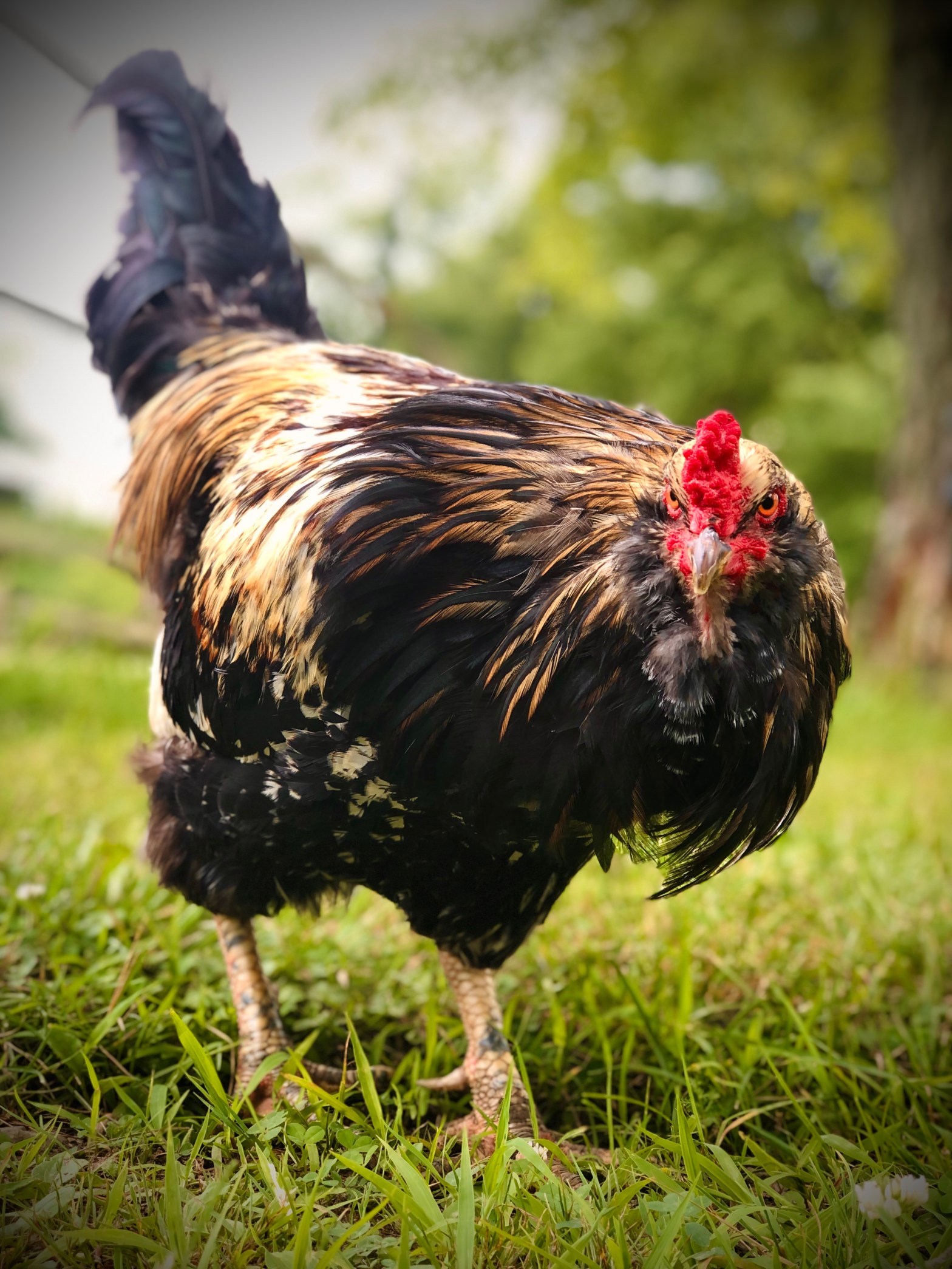
“Aggressive roosters are predisposed to aggression, due to their extreme testicle size. It’s an anatomical anomaly that makes it unavoidable.”
But, is it really?
Time after time, I see dissections of roosters where the person exclaims, “of course he was mean, look at those huge testes!”
It seems as if, somewhere in the poultry world, people conflated the presence of large testes as the source of “unfixable aggressive behavior”.
But, while many chicken owners will open up an aggressive rooster and be quick to blame their temperament on anatomy, it’s actually environmental factors, in combination with behavior and base genetics, that determine testicular size and hormone production!
But, I don’t expect you to just take my word for it!
Here’s the Science
When first formed as an embryo, a rooster inherits genes from its parents that set a baseline for its potential testicular traits. However, there are a large variety of environmental factors that can influence the way in which those genes are expressed.
Study #1: The Effects of Housing and Accessibility to Hens on Hormones and Testicular Size
In a 2021 study, “Rearing system influences the testicular development, semen quality and spermatogenic cell apoptosis of layer roosters” (Du, et al., 2021), 135 cockerels were placed into various living conditions (colony, large cage group, and single cage) and studied for variance in reproductivity.
It was found that, while all roosters experienced rapid testes growth and increased hormones in plasma during their main growing phase, roosters kept in colony groups ended up with dramatically higher testicular weights by the last test day (210).
They also showed higher measurements of hormones FSH, LH, and T than roosters kept in both the large cage groups and single cage environments.
Overall, it was concluded that increased exposure to hens and more space both increased testicular size and reproductive hormone levels.
Study #2: The Effects of Dietary Supplementation on Hormones, Seminiferous Tubule Diameters, and General Reproductivity
Another study, “The effect of l-arginine and flaxseed on plasma testosterone concentration, semen quality and some testicular histology parameters in old broiler breeder roosters” (Abbaspour et al., 2019), took a look at the dietary influence on testicular growth and reproductivity.
36 Ross-308 Cornish Cross broiler breeder roosters with similar weights were fed three different levels of l-arginine (0.52, 0.68, and 0.83%) and flaxseed (0, 2, and 4%).
As a result, it was found that dietary supplementation of arginine (an amino acid commonly found in meat, seeds, soybeans, whole grains, and legumes) by 0.68% increased blood testosterone, semen quality, and spermatogenesis.
Roosters supplemented with flaxseed by 2% resulted in higher seminiferous tubule diameters than roosters given no flaxseed supplement.
Study #3: The Effects of Apple Pomace on General Reproductivity and Testicular Traits
Furthermore, an additional study, “Reproductive performance, semen quality, and fatty acid profile of spermatozoa in senescent broiler breeder roosters as enhanced by the long-term feeding of dried apple pomace” (Akhlaghi et al., 2014), reinforced the concept of a diet’s effect on testicular traits.
Researchers found that feeding apple scraps, specifically apple pomace, greatly increased several reproductive characteristics, including seminal TAC, fertility, and hatchability rate.
Study #4: The Effects of Age, Weight, and Level of Stimulation on Testicular Size and Function
Diving even further, in “Relationships Between Fertility and Some Parameters in Male Broiler Breeders (Body and Testicular Weight, Histology and Immunohistochemistry of Testes, Spermatogenesis and Hormonal Levels)” (Fragoso et al., 2013), researchers discovered that a rooster’s age, weight, and level of stimulation at the time of testing all affected their overall testicular size and function.
Specifically noted was the description of a rapid increase in testicular size and testosterone after light stimulation, across the board, along with findings of testicular shrinkage and hormone reduction once the roosters had aged.
In addition, they found that when younger roosters with more body mass outcompeted the older and lesser males, a hierarchy was formed, which was accompanied by a strong decline in the overall reproductive success of the other males.
In short, roosters that are younger, heavier, and have been recently stimulated had been found to have increased testicular size and function than roosters that are older, lighter, and have received little to no recent stimulation. It was also found that the social hierarchy of each rooster plays a substantial role in their reproductive anatomy and function.
Study #5: The Correlation Between Aggression, Food Intake, and Body Density in Combination with Genetic Markers
When looking specifically at aggression, strong correlation with environmental factors was also found.
In “Genome-wide association study of aggressive behaviour in chicken” (Zhenhui, et al., 2016), a total of 300 male Chinese native, dwarf yellow meat-type chicks were raised and observed for various aggressive behaviors, such as threatening, attacking, chasing, aggressively pecking, fighting, and leaping towards other males. Their food intake was recorded and blood was taken at various times to both genetically test the birds and monitor their hormones, along with pituitary samples being collected from the top three most and least aggressive birds in the group.
Researchers found that, while as many as 40 gene markers could be positively identified as a potential cause of aggression, there was also significant positive correlation between daily aggressive frequency and daily feed intake. They also found that, while aggressive roosters were noted to eat more, they did not gain a proportional amount of weight from that additional food intake – suggesting a correlation between energy intake, body density, and aggression.
This study also introduced the theory that aggressive roosters were more than just a nuisance, but rather a financial and efficiency issue as well.
What Does That Mean?
To sum it up, a rooster’s testicular size and overall functionality are greatly variable and can be directly influenced by a number of environmental factors!
Everything from how you house them, to what they eat, how many hens they have, and their overall lifestage could be the difference between opening them up to tiny, little cashews… or full-sized peanuts!
Diving Deeper
“But, then why is it that seemingly “every time” you open up a mean rooster, it has giant testes?”
Well, there’s a few reasons!
When you think about aggressive roosters, they typically fit a lot of the same characteristics:
- They’re often the dominant bird in the group, therefore having the most hens out of all of the roosters in the flock (ie. ample and frequent stimulation).
- They’re seldom the birds that get bullied away from resources, so they typically have ample access to feed, scraps, and other foods (usually containing those growth-promoting amino acids).
- And, since they receive ample food portions, they often have great body condition (promoting testicular growth).
- It’s also worth mentioning that most people with aggressive roosters are more likely to process them sooner, versus more docile roosters that may have a lengthier lifespan and be slightly older when processed or dissected (the majority likely never being opened up at all) – increasing/decreasing their testicular size accordingly.
Now, compare that to a rooster that is more likely to get bullied away from feed, “owns” less hens, and has a lower body condition…
If you were to butcher the two, I’m sure you’d find quite the distinction!
However, the corresponding personalities of each “type” aren’t always the case.
“So How Does Personality Fit In?”
While aggressive roosters are more likely to have the environmental and behavioral characteristics that encourage testicular growth, aggression is not a necessary component for that process!
You could have a very docile, dominant rooster with giant peanuts just like you could have a horribly aggressive one, with lower flock status, and teeny, tiny cashews.
Conclusion
While many believe that aggressive roosters are anatomically predisposed to aggression due to the size of their testicles, it’s actually a lot more nuanced!
Environmental factors play a much larger role in testicular growth than what is commonly believed, far beyond a rooster’s inherited genetic traits, and ultimately shape their anatomy accordingly.
Having large testes doesn’t guarantee aggression, just as having small or average-sized testes doesn’t guarantee a rooster will be tame. It’s simply a physical effect from their environment on the base genes passed down from their parentage.
Overall, aggressive roosters are more likely to possess traits and flock status that promote testicular growth, but testicular size should be viewed as an effect of that behavior, not a cause.
Citations
Xiaxia Du, Fei Qin, Felix Kwame Amevor, Qin Zhu, Gang Shu, Diyan Li, Yaofu Tian, Yan Wang, Xiaoling Zhao, Rearing system influences the testicular development, semen quality and spermatogenic cell apoptosis of layer roosters, Poultry Science, Volume 100, Issue 8, 2021, 101158, ISSN 0032-5791
https://www.sciencedirect.com/science/article/pii/S0032579121001929
Behnam Abbaspour, Seyed Davood Sharifi, Shekofeh Ghazanfari, Shirin Honarbakhsh, Abdollah Mohammadi-Sangcheshmeh, The effect of l-arginine and flaxseed on plasma testosterone concentration, semen quality and some testicular histology parameters in old broiler breeder roosters, Theriogenology, Volume 128, 2019, Pages 101-109, ISSN 0093-691X,
https://www.sciencedirect.com/science/article/pii/S0093691X18307696
A. Akhlaghi, Y. Jafari Ahangari, M. Zhandi, E.D. Peebles, Reproductive performance, semen quality, and fatty acid profile of spermatozoa in senescent broiler breeder roosters as enhanced by the long-term feeding of dried apple pomace, Animal Reproduction Science, Volume 147, Issues 1–2, 2014, Pages 64-73, ISSN 0378-4320,
https://www.sciencedirect.com/science/article/pii/S0378432014000852
J. Sarabia Fragoso, M. Pizarro Díaz, J.C. Abad Moreno, P. Casanovas Infesta, A. Rodriguez-Bertos, K. Barger, Relationships Between Fertility and Some Parameters in Male Broiler Breeders (Body and Testicular Weight, Histology and Immunohistochemistry of Testes, Spermatogenesis and Hormonal Levels), Reprod. Domest. Anim., 48 (2013), pp. 345-352
https://onlinelibrary.wiley.com/doi/10.1111/j.1439-0531.2012.02161.x
Li, Z. et al. Genome-wide association study of aggressive behaviour in chicken. Sci. Rep. 6, 30981; doi: 10.1038/srep30981 (2016).
 Hayyy Farms