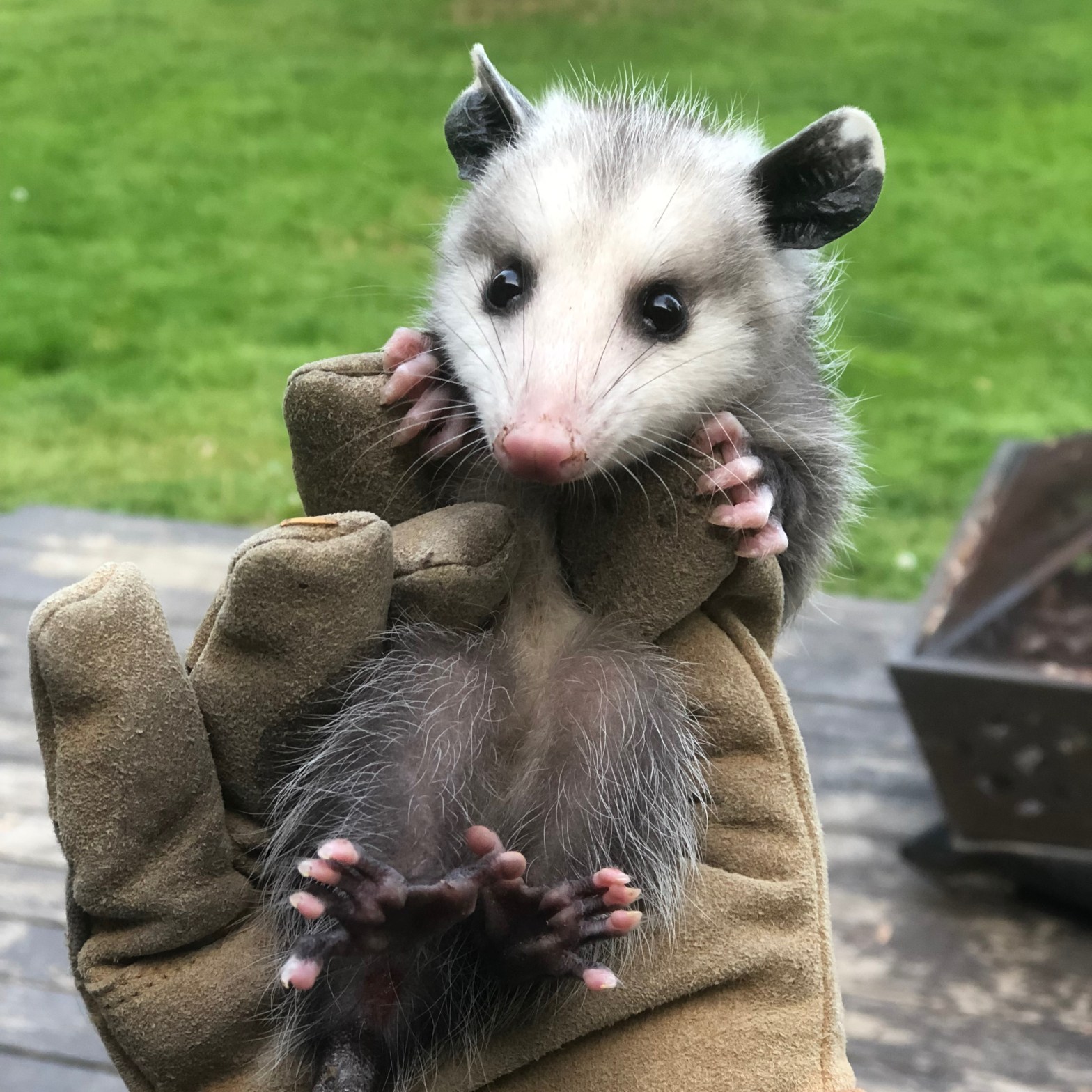
It’s been a fairly recent idea that opossums are the epitome of tick control. Society has gone from viewing these marsupials as disposable pests to valuing their presence around the farm as a form of natural tick removal, all in the span of about 10 years. They are so widely accepted now, in fact, that farmers and homeowners alike are even intentionally letting them roam their lands, in situations where previous generations would have merely dispatched and disposed of them.
But, where do they actually stand?
To figure out whether or not they’re actually the tick vacuums that society thinks they are, we have to take a look at where this information came from in the first place.
The Initial Experiment
You see, the idea that opossums eat ticks was actually based on a 2009 study by the Cary Institute of Ecosystem Studies that was done on opossums in captivity. The study was conducted on six different animal species – white footed mice, eastern chipmunks, grey squirrels, opossums, veeries, and catbirds – and measured their ability to remove ticks from themselves.
To simulate a tick-infested environment, the scientists placed 100 larval deer ticks on each animal’s head and neck with a number 00 paintbrush, confined them in a motion-restricting chamber for 4 hours to allow them time to attach to the body, and recorded the amount that dropped from the body over the course of 4 days. Any ticks unaccounted for were assumed to have been eaten or destroyed by the animal when grooming itself.
Out of all six species tested, the opossums had the largest tick removal rate (83-96.5%).
With that data, the scientists then used equations to predict the amount of ticks “trapped” (eliminated) by each animal within their simulated ecosystem and how that would shift the tick burden (density) between the other five commonly-infected species being tested.
Overall, it was predicted that, within that simulated ecosystem, opossums would eliminate 5,686 larval ticks.
However, these statistics haven’t held true to opossums in nature.
New Research
Many scientists and fellow researchers took interest in the Cary Institute’s findings and wanted to see how they translated to opossums in nature. This is where their data went off the rails – metaphorically speaking, of course.
A 2021 study published in Ticks and Tick-borne Diseases actually disproved the 2009 study’s predictions when they examined the stomach contents of 32 wild opossums in central Illinois. Using a microscope to look for ticks and ticks remnants, they found no signs that any of the opossums had been eating any ticks.
Furthermore, 23 additional diet analyses performed by other independent researchers – 19 performed on stomach and digestive tract contents and 4 examining scat – came to the same conclusion: none of the opossums that they had studied had been eating any ticks either.
What gives?
Where the Initial Experiment Went Wrong
The biggest scientific pitfall of the initial 2009 study was that there was no control done to eliminate non-typical behaviors caused by bringing wild animals into a laboratory setting, which they were unconditioned for and unused to. In other words, animals that were initially wild were suddenly caged and put under extreme duress. Any major change such as this can intensely affect their behavior, even causing excess grooming that doesn’t typically occur in nature.
Another major pitfall was the fact that the study only focused on how effective each species was as a host. Only the ticks that dropped off the body after 4 days were assumed to be “effectively hosted” and recorded, however this didn’t account for a large portion of the originally introduced ticks that could have still been remaining on the body. Instead, it was assumed that any ticks unaccounted for after 4 days were groomed away by the animal and destroyed. Since ticks can feast for up to 6 days before dropping off, the initial study leaves two entire days’ worth of live ticks unaccounted for. This major discrepancy creates a huge scientific gap to debate whether or not any of the study’s findings could even be considered accurate in the first place.
Essentially, the researchers had taken wild animals, put them in unfamiliar situations of extreme stress, used the resulting altered behaviors to make a blanket statement for the entire species, and then left two whole days of research unaccounted for.
Not the best plan, when you think of it that way.
Where They Stand Now
With all of the new research that has been coming out in opposition of the initial study, it’s safe to say that opossums are definitely not the tick-eating machines that we once thought they were. Their short reputation as nature’s tick vacuum was based on a faulty experiment that not only disregarded taking the necessary steps to prevent environmental bias, but also left a gaping numerical hole in their data.
In reality, opossums are most renown for being America’s only native marsupial. They wander around cleaning up food scraps, birds, beetles, and dead animals, leaving the environment a less smelly and bug-filled place.
However, while we love opossums for their cute faces, weird toes, and important place in keeping the ecosystem free from edible waste, unfortunately they won’t be helping us with our ticks.
Gone are the days where a farmer can grow his own grain, bale his own hay, and feed his animals completely off of the land that he owns. Sure, someone may still be able to do that somewhere, but the population is rising and the land that was available for farming in the 80’s and 90’s has drastically dwindled now coming into 2022. That being said, many farmers now need outside support in feeding their livestock in addition to what they may still be able to grow themselves.
As we all know, this can be expensive!
For established family farms, these pricey statistics, significantly worsened by current inflation, can jeopardize the livelihood of entire generations. And for beginners? Many rethink raising livestock at all.
It’s time to get crafty.
Here’s a list of 10 genius ways you can cut costs on your family farm or homestead – without sacrificing quality!
The utmost important way to reduce feed costs is to choose species and breeds that best fit your farm.
Somehow, this bit of information gets pushed to the back of people’s minds when purchasing livestock. Many buy the biggest, best breed they can find without considering the intake of that breed to be able to get those desired results.
For example, in the realm of meat chickens, many farmers choose the Cornish Cross for their rapid weight gain. However, the Cornish Cross also eats significantly more during that time than any other breed and supporting most of their diet with grain is a requirement. For someone with a smaller feed budget and less access to grain, Cornish Cross would be a difficult bird to raise. To that individual, a breed like a Red Ranger might be much more appealing. Although Red Rangers grow slower than Cornish Crosses, they forage better and therefore need less grain. Having a smaller feed budget, but ample foraging space would make Red Rangers the better choice for that particular farm.
Or take cows, for example. The average holstein cow produces 9 gallons of milk per day. For a commercial dairy, that’s perfect! However, for a small farm or homestead with no usage other than direct consumption, it would be nearly impossible to go through enough milk to outweigh the cost to feed that cow. In their situation, it might be more economical to choose a breed that produces less milk, but requires less feed to do it. They might consider a breed like the Dexter, that is better able to thrive on pasture and produces around 2 gallons of milk per day.
In all aspects of livestock rearing, there will always be a breed that leads in production, whether it be meat, milk, eggs, etc. However, that doesn’t always mean it’s the most economical breed for every farm. Sure, they might produce more, but if the breed needs a number of resources that you aren’t able to provide, it’s going to be a far more costly decision than choosing one that’s more suited to your needs.
When determining the breeds you want to raise, it’s extremely important that you look at the individual needs and stipulations of each breed and decide which will add the most value for your effort. Take into consideration their dietary requirements, whether or not supplemental feed is needed, how well they forage on pasture, what the yield might look like, and if they fit with your farm’s production overall.
In the grand scheme of things, more isn’t always better!
Each species of livestock has what I like to call “hidden talents”. These talents are potentially useful actions that the animals may do naturally, that we normally may ignore or discourage. However, these behaviors can be turned into huge time and money-savers with a little bit of ingenuity!
For example, pigs love to root through the dirt! This is something that is normally prevented and discouraged in many operations, and for good reason. Farmers don’t want to tear up their barn floors! However, these same farmers also break out their tiller come spring and spend money and labor prepping their fields for the season. If you’re in the business of saving money (aren’t we all?), you might realize that you have the perfect tilling machine sitting on the sidelines, one that saves a large amount of time and labor. Instead of spending time and money on equipment and labor to till the fields yourself, you can utilize a natural skill that your pigs already have… for no higher cost than the money you’ve invested in them anyways!
Now, that’s not to say that you should get pigs just to till up your gardens and fields. Every species has its own talents, which means that you can take any livestock you already own and find ways to utilize them to increase your farm’s efficiency.
Let’s talk about the farm staple: chickens. Chickens love to scratch and dig in the dirt while looking for bugs and worms to snack on. While this might not be useful in most locations, this can be extremely beneficial in areas like compost and manure piles. With the right setup, you can persuade the chickens to turn your piles for you in lieu of having to do it yourself, giving you more time to do other things that add value to your farm. After all, time is money! All it takes is easy access to the compost pile, either free-ranging or inside a run, and you’ll have compost in the works without lifting a finger!
When working with your livestock’s strengths, ask yourself: “What do my animals do on a daily basis? What are they good at? What behaviors do they show naturally?”
If you can figure out what your livestock are good at, it’ll be easy to manage them in a way that best contributes to your farm or homestead. All it takes is some creativity!
Livestock are amazing upcyclers! Because they can eat digest foods that humans normally don’t eat, they’re able to consume things that would normally be considered “waste” in other industries, such as spoiled vegetables, expired milk, and other edible waste.
Due to the fact that these nutrients are considered waste, many businesses and organizations are more than willing to give them to farmers in lieu of paying to take them to the dump. All it takes is a polite inquiry and you might find yourself with large amounts of livestock feed… for free!
Here at Hayyy Farms, we do a lot of upcycling! We run after-Halloween campaigns within the local community to upcycle undecorated pumpkins to feed our animals and receive vegetable scraps and spoiled produce from some of our lovely customers on a semi-regular basis. However, our biggest help so far has been our contact with a local brewery! The brewery employees notify us when they’re planning a brew and we show up to collect the grains after they’re done with them. The amount we have access to ranges anywhere from 250-750 lbs per brew, but we only pick up what we can use within a reasonable amount of time. For them, the hundreds of lbs of spent grains are a nuisance to get rid of, but, for us, they’re a wonderful source of fiber and protein! It’s a win-win and the benefits are completely free for both parties!
The most important aspect of using byproducts, though, is to make sure you’re feeding them in safe quantities. They should never completely replace the animals’ diet, but instead used as a supplement alongside their normal food. If done right, the animal will consume just as many nutrients as before while eating less of their regular, expensive feed.
Not sure what to look for? Here’s a quick list to give you some ideas:
Baked Goods
Bran
Brewery Grains
Chaff
Cut Flowers (safe varieties only)
Eggs
Expired Bread
Liquid Whey
Milk
Nuts
Spoiled Produce
Table Scraps
Wheat Middlings
And More!
This list is not species specific! Please take into consideration which of these byproducts would best fit the livestock that you raise before attempting to feed them.
These aren’t the only byproducts available, but it’s a great place to start looking. The opportunities are endless! Be sure to ask around politely and, before you know it, you’ll be cutting down your feed costs in no time.
A filler is a food component that’s used to help keep an animal full by providing dietary fiber and creating bulk in the feed. It’s meant to decrease consumption of the more nutritious feed components, which are more expensive than the filler. In general, a filler can be anything added to the feed that doesn’t contribute much to the nutritional value.
I know what you’re thinking, “wouldn’t the byproducts in the previous point be considered a filler?” Some of them, yes. The brewery grains are a good example of both a byproduct and a filler. Since spent grains are roughly 80% water and only 20% fiber and protein (by weight), they provide the substance needed to help satisfy the animal’s appetite, but not enough nutrients to really be an active part of the diet.
However, I wanted to emphasize that not every component in livestock feed, or any feed for that matter, has to be nutritional.
One very popular example is straw. Cattle farmers will often mix straw with higher quality forages to fill their animals’ guts and keep the ration from getting too dense. Since straw is often much cheaper than higher quality forages, it’s extremely beneficial for lessening the cost of the feed, while physically giving the cattle the same amount of food. Straw doesn’t really have much nutritional value (apart from fiber and a small amount of protein), however it can still benefit the diet by adding in bulk.
Keep in mind that fillers should be used responsibly and measured to ensure that the animal still gets the required nutrients for proper growth. You can never completely replace nutritious feed, but fillers used in appropriate amounts can help make that feed last a bit longer.
There are many different fillers you can use for each species of livestock, so it’s best to research the best and most effective fillers for the animals that you raise.
Often times, people will look to chain stores for their feed and grain needs. To be fair, it’s not a terrible decision! Chain stores are well stocked and very publicly known, making it convenient to stop in and shop for what you need. However, this is not going to spare you any pennies!
If you’re looking to cut down on feed costs, you’re going to want to find somewhere that sells feed for less than chain retail prices. Your local feed mill can help!
Local mills are often times much cheaper than chain stores with a greater variety of product. Not only do they have local mixes for lower costs per lb, but they often have the ability to custom-mix exactly what you need for a fraction of the price. This can be extremely cost-effective if you have livestock with specific nutrient needs or need to purchase your feed in bulk. Since they’re often family owned and operated, their grain is also usually more locally-sourced, with better deals than you’d find at a chain store.
By doing business with your local feed mill, you can cut costs while supporting local families!
It’s no secret that people will pay premium for “pretty”.
Whether it’s a red painted mini-coop with white trim, a decorative herb planter, or the cozy-looking nesting boxes with the tiny windows, it’s all designed to be so ”pretty” that you ignore how much of an upcharge there is on it.
Don’t get me wrong, I would love a coop door in the shape of an egg. However, expensive visual satisfaction is not what’s going to help my growing farm survive.
When deciding if a product is actually economical or merely “pretty,” ask yourself these three questions:
Do the materials used justify the price?
How does it function in real life?
If it was undecorated, would I still pay this price for it?
If the product is cheaply made and inconvenient to use, you can be positive that they’re attempting to sell it based on appearance alone.
One major example is those tiny coops they’re always selling at feed stores. They’re cute, right? They have the fancy latched doors and the fold-down ramp, complete with an immaculate paint job and fancy trim, and, oh how tiny! That’s where they get you.
If you look past the fancy appearance, you’ll see that they’re actually terrible to use in real life and only really work for a small percentage of people. Those coops are never insulated, which in most states is a huge problem if you’re running anything other than a small frozen chicken factory. They’re too small to comfortably clean and concentrate a large percentage of droppings in a small area, which, if left alone, is just begging for disease. In addition, most of them only hold about 6 birds, at best, or even less if you chose a larger breed. If the owner decided to expand their flock, they would quite literally have to get rid of or repurpose their coop and purchase another larger one instead. When these coops range anywhere from a few hundred dollars to a few thousand, this route is nothing but money down the drain.
However, there are a ton of other resources and products available that are far more focused on functionality!
By avoiding the “pretty” products, you’ll be able to spend far less money for products that work just as well, if not better, than the more expensive ones.
“One man’s trash is another man’s treasure” – Anonymous(…but probably your Uncle Richard after finding the latest “fixer-upper” on the curb)
Let’s be real, what better way to cut costs than not buying things in the first place? If you can turn an unwanted item into something useful, you save 100% of what you would have spent on that item in the store!
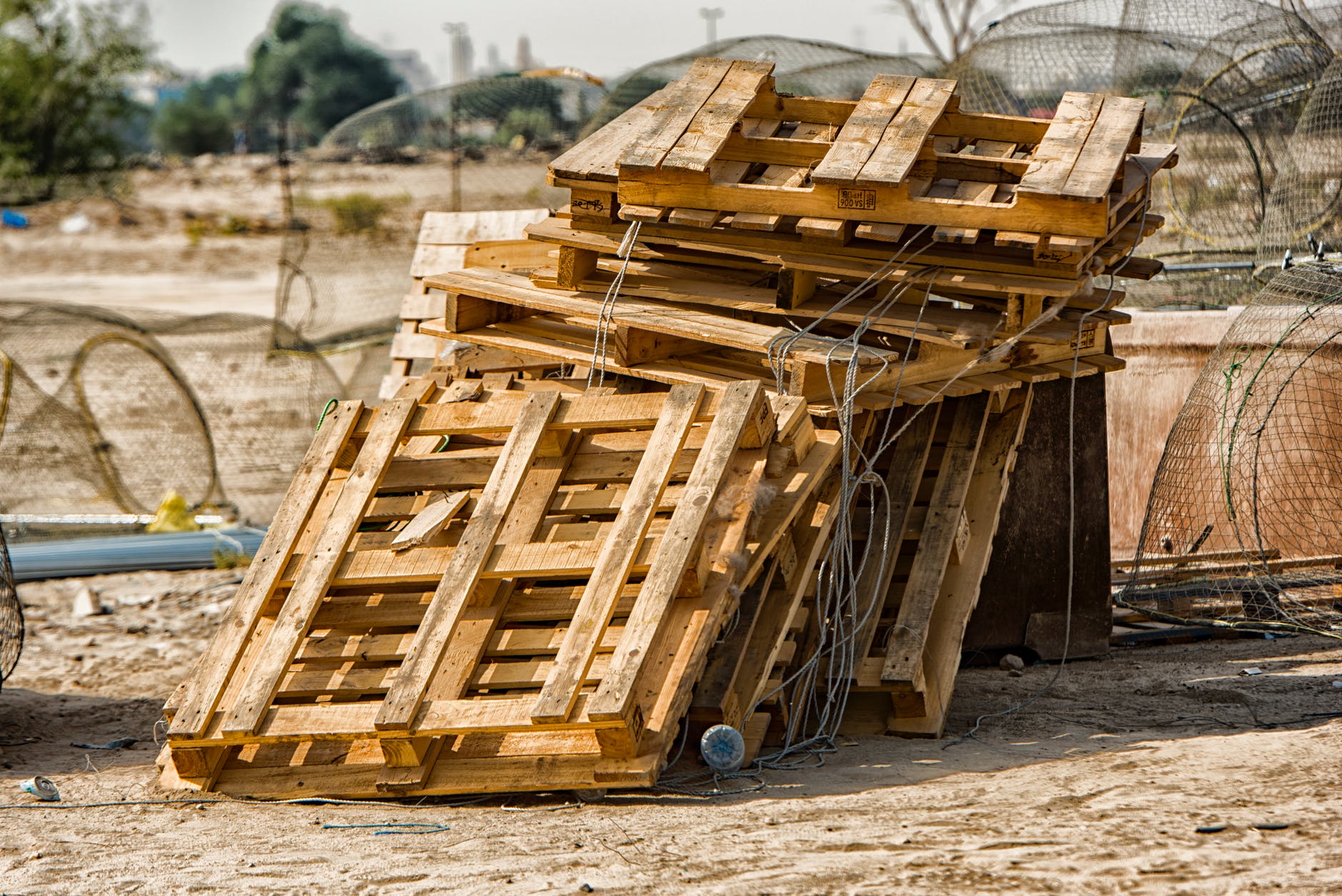
That scrap lumber sitting in a pile? Make a raised bed for gardening! Need a sturdy enclosure? Try sourcing free pallets and building it that way! You found old rain barrels? Turn them into feed containers!
The possibilities are endless, and you’ll save money every time!
Have you ever thought about just how many items in our daily lives are single use? I’m not necessarily talking about packaging plastic or paper cups (although, those are a hot topic as well), but products you’ve purchased that only perform one function?
Housing is a big one that I’ve noticed over the years. Many people seem to think that livestock need very specific enclosures in order for their farm to “do it right”. However, that couldn’t be more false!
Let’s take chicken coops again, for example. Imagine that you purchase one of those extremely tiny coops for your hens and a few years later decide to stop raising chickens. What are you going to do with your coop? It’s too small and specifically built to house big livestock and you can’t really use it as storage. If you no longer raise poultry at all, the only valuable second-life for it would be firewood, expensive firewood, at that.
However, if you had raised your chickens in a multi-purpose building/enclosure, you would simply be able to turn it into something else and give it another useful purpose that would better suit your farm.
“Well, how do I do that?”
On the topic of enclosures, one huge piece of advice I like to give farmers is to find themselves a shed. Why a shed, you ask? In my opinion, a shed is the most versatile thing you could have on your farm. Let me explain.
Picture this: You start out with an empty shed. Then, you decide to raise chickens, so you add nesting boxes, perches, and a ramp, converting your shed into a chicken coop. However, you get bored of the chickens and want to raise goats instead. Now that the chickens are gone, you take out the boxes, perches, and ramp, then add in a trough and house the goats inside. Well, it turns out goats aren’t your thing either. That’s okay! Luckily, your new feeder pigs don’t mind the setup and quickly find themselves at home. Months go by, you send them to butcher, and now you’re back to an empty shed, ready to house the next batch of animals or keep your items safe in storage.
A good shed can be used for absolutely anything. It’s the farmer’s gift that keeps on giving! Not only can it house animals, store equipment, secure feed and grain, and become a tack room, but you can also take it apart for the raw materials to build other structures, if you no longer have a use for it. In addition, you can often find them inexpensively if you know where to look. Many people sell their used sheds for extremely low prices, which, funnily enough, often makes them cheaper than species-specific structures for the initial purchase, not to mention the value every time it gets repurposed.
Sheds are obviously not the only multi-purpose item you can incorporate into your farm, but they’re definitely one of the most cost-effective! With the vast amount of options out there, I heavily encourage you to look into your own operation and find areas where you could incorporate a multi-purpose item or structure.
As a fellow farmer, I know just how costly it is to have professionals out on the farm. Between hoof care, wound care, and regular veterinary work, the prices add up quick! However, with much research and practice, you can learn to do some of these things yourself.
One of the first things I learned upon starting my farm was giving injections. I knew that I didn’t want to have to depend on a veterinarian for something so little that I knew I could do myself. Therefore, I spent vast amounts of time researching different types of vaccines and medications, proper protocols for each type of injection, and listening to professionals speak on the appropriate ways to administer each method of injection to each of the species that I owned. I well prepared myself and have been successfully giving my own injections ever since.
If injections aren’t your forte, there’s always other skills you can learn such as shearing, hoof care, wound care, basic reproductive care, and emergency procedures like how to remedy certain birthing complications.
None of this is to say that you can just wake up one morning and do any of these skills with zero preparation. Never attempt something if you aren’t confident in your ability to do it safely! You have to take the time to educate yourself, and it might not be easy, but it’s cheaper in the long run to practice proper safety than it is to under-prepare and cause larger problems.
“Where can I learn?”
The best resources you have available are the professionals that see your animals on a regular basis. They’re going to be familiar with your situation and should be able to guide you on any questions you may have, especially since they already have a professional relationship with your livestock.
However, for the sake of general knowledge, I would also heavily suggest looking to credible medical websites and watching videos produced by experts to really understand the underlying mechanics of each topic. It may seem like overkill, but the best way to do a proper job is to learn why the job must be done that way in the first place.
There are always going to be skills that you won’t be able to do yourself (not without a fair amount of classes at least), but that doesn’t mean that you can’t take a few small things onto your plate – and off your budget!
Have you ever purchased something of lesser quality because the better quality option was too expensive? Or settled for a product that doesn’t work as well to try to save money? If you said yes, this tip is for you.
Compounding costs are one of the most detrimental costs to your operation that you might not even realize.
Compounding costs are costs that occur on a regular or semi-regular basis that initially seem small, but add up over time. They can go undetected for long periods of time because they’re small enough to avoid major concern, but increase over time to put a massive, invisible strain on your finances.
Let me give you an example.
Imagine going to the store for new work boots. There’s two pairs of boots in your size, one is a high quality, brand-name boot for $100 and the other is a mediocre quality, generic brand for $20. Now, your first reaction, and mine as well, would likely be to save $80 and settle for the generic boots. However, this is not always the cheaper option.
You see, generic boots are often much less durable than the more pricey brands, meaning they wear out much quicker than boots made of higher quality materials. Because they don’t last as long, you will most likely be purchasing multiple pairs of generic boots over a long period of time as opposed to purchasing only one durable pair. Therefore, you can’t compare the prices as they are ($20 and $100). You have to compare the prices as they’ll look over time.
I find that generic boots generally last me about a year before they start ripping at the seam and my high quality boots usually last me 5 years or more. I’m not too rough on my boots, but I do wear them for extended periods of time every day, so I feel comfortable using those numbers as an example.
So, say my high quality boots last me 5 years. I will have either spent $100 on a single pair of high quality boots, or $20 on generic boots 5 times… which is also $100. In this case, it costs the same to have better boots as it does to settle for ones I don’t particularly like as much. Now, if my high quality boots last me 6 years, I will have either spent $100 on better boots or $120 to settle for less.
In other words, my first impression would be that I’m saving $80… but I might not actually be saving that much.
This isn’t only an issue with attire, but a huge problem with equipment, livestock products, and especially in fencing decisions, where high prices leave farmers choosing inferior fencing materials… which they end up having to pay to replace over and over again.
Don’t let the price tag fool you, compounding costs will leave you paying a premium for the mere impression of saving money.
“How do I avoid them?”
The best way to avoid compounding costs is to take each price tag and figure out how often you’ll be paying it over a set period of time. Figure out the exact equilibrium where the products will cost the same. Is it a year? Is it two years? If the more expensive product will last longer and cost less over time than the cheaper one, you know it’s going to be the more economical option.
Remember, the price tag only shows what you spend on one purchase, not what you might be spending overall.
Today’s farmers have it tough. Not only do we undertake the same labor-intensive tasks as the previous generations, but now our resources to do them are dwindling.
Luckily, there are many ways you can help cushion those uncomfortable costs.
These money-saving tips are a culmination of everything I’ve learned in my agricultural journey thus far. I implement each and every one of them here at Hayyy Farms to keep my costs as low as I can, without sacrificing the care of my livestock. They work amazingly on my farm, and they can help yours too!
I hope that, by reading this, you’re inspired to use at least one of these creative tips to keep your farming dreams a reality.
Anyone who’s involved in agriculture will tell you the same thing: to support your local farmers. However, something that’s not talked about nearly as much is how you can support your local farmers.
People who are involved with farming are often guilty of forgetting about how ordinary, everyday people may perceive the advice they hear. We know what it means to support local farms, but we don’t always take into consideration that not everyone does. I am especially guilty of this myself. I find myself repeating this bit of advice (a plea, if you will) and not elaborating on ways to accomplish it. No more.
Here’s a list of 6 easy ways to support your local farmers!
If you’re in the market for farm products or fresh produce, take your local farm into consideration. They have a lot of neat things to offer! Their products often have a much better quality than anything you can find at a chain store, because all of the components come straight from the farm. Every product is thoughtfully made with the freshest ingredients from happy, healthy animals!
Did you know, commercial eggs sold in grocery stores are often an average of 60 days old when they reach the shelves? That’s right! Once they complete all of the checks and reach all of the sanitation standards that the companies must follow, the eggs are an average of 60 days old. However, if you support local farms, you could be buying much better quality eggs that may have even been laid as fresh as that morning.
“CSA” stands for Community Supported Agriculture. When you sign up for a CSA, you’re basically signing up for a share of a farm’s produce during the growing season. Depending on the farm, this could include fresh fruits, vegetables, mushrooms, herbs, milk, eggs, and even flowers. Each shareholder receives the satisfaction of being sent the freshest, healthiest food and knowing exactly where it’s coming from. Some CSA’s also host social events and classes for their members, so be sure to check the ones near you to see what they have to offer!
While an amazing way to get a variety of fresh foods, this is especially helpful to the farmers running the CSA. It gives the farmer money upfront to buy the needed materials to start the season and guarantees that all of the produce will be sold at the end. It takes away all of the worry about having to market anything and allows the farmer to focus on their livestock and crops. For both producer and consumers, it’s a win-win!
Farm-to-table restaurants and cafe’s are a godsend when it comes to supporting local farms. Not only do they provide the community with tasty and quality food options, but they also play a big role in keeping local farms afloat. These establishments serve many people within the community, which means they need to buy large amounts of ingredients to continue producing enough food. This provides the farmer with a consistent buyer of large quantities of things like fresh produce, meat, eggs, milk, cheese, and even honey.
By dining at local farm-to-table restaurants and cafe’s as opposed to chain restaurants, you’re supporting not only those local businesses, but also the farms that supply them. All for the price of a delicious meal, it’s a win-win!
What better and easier way to support your local farms than by expanding their potential customer base?
Farming is tough! At the end of the day, many farmers don’t have the time nor energy to be very active online. This often means that the posts and pages they make don’t get a whole lot of attention, when they do manage to post at all.
The only way to make money while farming is selling fresh products and produce to others. Whether that be fruits, vegetables, animal products like milk or fleece, or even the animals themselves, the only money to be made comes from people knowing about their farm and what they’re trying to sell. This is why it’s extremely helpful when others interact with their pages and share their content. Any interaction on social media (such as likes, comments, shares, and follows) allows the post to be seen by more people, which broadens the number of people who might be interested in their products and increases the potential sales they may make.
Did you know, according to marketing professionals, that people who are referred to a business by a friend are four times more likely to make a purchase? It’s no secret that you, as a consumer, hold the power to determine which businesses get community support.
If you find that you really like the farm or the products they offer, refer a friend! Any and all business is extremely helpful in the long run, especially in an industry that eats profit like… well… hay!
This last idea is for anyone who runs, owns, or works at a food-related business.
As we all know, food has an expiration date. When it’s past its prime, many businesses remove any old food from their shelves, inventories, and sales floors and throw it in the dumpster. However, animals are amazing upcyclers! They can still consume food beyond its expiration date as long as it’s not moldy or overly spoiled. Edible foods include fruits, veggies, pastas, milk, and byproducts, such as spent grains and even certain ingredients used to make candy! These foods and byproducts that would otherwise be sent to a landfill are, instead, able to be utilized by livestock and turned back into healthy food for the local community.
Instead of sending food waste to a landfill, contact a local farm to see if they would like to use some of it to feed their animals! It’s a great way to be eco-friendly while cutting costs on both ends. The store owner will incur less fees for waste removal and the farmer’s feed costs will go down, allowing them to provide more food for the community at a lower expense. It’s a win-win!
Local farms are essential in maintaining a happy, healthy community. They provide quality, responsibly-sourced food at a reasonable price and give consumers more control over how their food is raised. However, because they’re much smaller than industrial farms, they do need a lot more support.
You can help!
By following these easy tips, you can help your local farms thrive! Whether you’re interested in joining a CSA, buying produce, or just following along on social media, there’s plenty of options available no matter what your budget looks like.
Shop local, eat healthy, and don’t forget to support your local farmers!
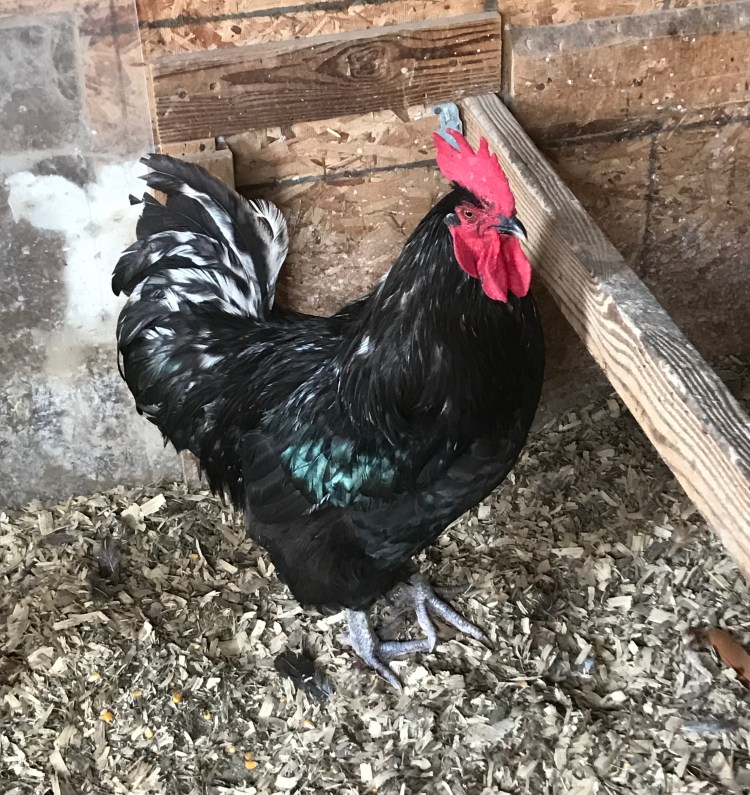
When it comes to proper training and handling, it seems like roosters get the short end of the stick. If they’re too easygoing, some people dislike them over their lack of instinct. However, if they’re too aggressive, others resort to fresh chicken soup. Between a set of instincts to protect their hens and enough decency to not maim their human handlers, it’s a tough line to walk for a lowly bird.
What’s a flock owner to do?
Do you cook your prized rooster? Will you send him next door? Or are you destined to put up with his nonsense for eternity?
Fear not, I can help.
I’ve been working with and training roosters for over 10 years. When I say there’s not a single rooster I haven’t been able to handle, I mean it. I’ve worked with numerous roosters of my own, some purchased and some hatched here on the farm, and have also been hired in the past to help other flock owners with their roosters as well. I’ve transformed birds from aggressive and rowdy to superb citizens of the coop. To prove their polite demeanor, I even hand-select a few trained roosters from my own farm every year to bring to local kids events.
So, what’s my secret?
We’ll get to that shortly, but there’s a few things about animal training in general that you need to know.
Firstly, this is not the article for someone who just wants to be told what to do and then go on their merry way. There are a billion other articles on the web for that. I wanted to make something that dives deep into the thought process behind training and not just what works, but why it works. I wanted to expand on how the animal’s behavior is affected by the technique and give the reader an insight into training in general. Instead of saying “do this, that, and this other thing and your problem will be solved,” I wanted to give people the tools to really understand it, apply it, and even potentially use it to create a technique of their own. There are a billion different sites that will tell you cut and dry what to do, but I think you deserve more.
Now, when training, it’s important to realize that every animal is an individual with its own personality. Things that may work with one animal are not always guaranteed to work with another.
That being said, I’m not here to bash anyone else’s techniques or claim that mine are the best. Everyone has their own preferred steps and that’s okay. As long as a technique is humane and shows adequate results, it has just as much credibility as another. As the phrase goes: “there’s more than one way to skin a cat.”
Also worth noting is that training, in general, doesn’t happen overnight. Depending on the severity of the behavior and what you’re attempting to correct, it could take 30 minutes. Or, it could take 3 months. There is no official timeline to training that is going to tell you how fast an animal is going to pick something up. Don’t go into working with animals expecting it to happen right away and get frustrated and defeated when it doesn’t. Keep your expectations realistic, but your hopes high.
Now that we’ve got that out of the way, let’s get into it.
Make the wrong thing hard and the right thing easy.
When training animals, this is the phrase you’ll want to live by. It’s the absolute foundation for training just about any species and tells you exactly how you’re going to get your response.
Overall, animals will always resort to the behaviors in which they get the easiest and most pleasant responses. This can be in the form of a dog doing tricks for treats, a horse being taught to accept haltering through rest, or a deer taking the path of least resistance through the forest brush. It can even be seen in people! For example, a child who knows it’s easier and more pleasant just to listen to their parents and do their chores than it is to get grounded for arguing about it.
This phrase allows you to manipulate that basic behavior. In doing so, the goal is to make the wrong behavior so hard or such an inconvenience that the animal makes the conscious decision to choose to behave how you want them to instead, which they see as the easier option. They will view the negative behavior as unpleasant or too much work and consistently opt for the easier or more pleasant route.
In its simplest form, training an animal is when you give the choice to them and show them the correct decision. You say, “this is the situation, and this is how I want you to respond to it” and they make the conscious decision to make the right choice. By internalizing this phrase into your technique, you’re setting the animal up for success while biasing their choice towards an end behavior that favors you.
Most roosters are on the aggressive side of the scale. Not all, but most in an untrained state have more aggressive tendencies than not.
You can’t blame them, it’s in their instincts!
This can come in the form of beating their wings to look bigger and more threatening than the flock owner, squaring up to them, showing a lack of response and consideration to their general presence, or even pecking or spurring them. In other words, aggression doesn’t have to present physically to still be considered aggression.
This behavior is typically harder to see in roosters because their non-physical aggressive behaviors aren’t as universally known as other more-common species. For example, everyone knows that a dog that is growling or angrily barking is showing signs of aggression. They may not be actively biting people, but they would still be considered aggressive. It’s the same with roosters. There are many signs of aggression and not all of them are physical.
That being said, roosters still follow the tendency to choose the easiest options, which means this method will work for them.
So how do we combat this? We “make the wrong thing hard and the right thing easy.”
Let’s take a look.
Wrong behavior: Aggression (both physical and non-physical)
Right behavior: Submission/Cohabitation/Acceptance of Human Interaction/etc.
The end goal is to make the wrong behavior, aggression, seem like a harder/more unpleasant decision than the right behavior: allowing humans to interact with them peacefully.
Now, it’s important to note that the most important aspect in training is always self confidence. If a person is unsure of what they’re doing, it gives the animal an opportunity to get the upper hand. Always be calm, cool, collected and confident when training any animal.
When I’m training a rooster, before doing anything else, I walk into the coop and observe him. I look at where he is, what he’s doing, and determine his overall attitude that day. This gives me an overall idea about how he may act. If he’s acting normal, I feel good about continuing my training plans. However, if he appears sluggish or sick, I back off and choose to train on a day where he may be feeling better. You will never get a true response in an animal that’s not feeling well, so it’s important to quickly observe the situation to rule that out.
Once you’ve determined your rooster is healthy, you can continue with training.
When training a rooster, it’s important that you remain a neutral party. You don’t want any emotion or bias leaking into the situation, as much as you may dislike his rude behavior. A “clean slate” mindset will allow the rooster’s actions in that moment to set the tone of the session and keep you from acting more harshly than what is fair. By ignoring any past occurrences you’ve had with the bird, you’re prevented from using previous grudges to influence your current actions.
This also facilitates your training. With emotions in the mix, there’s no guarantee you won’t accidentally act out of spite. If this happens, the rooster won’t be able to clearly distinguish the cause of the training in the first place. You want him to make the connection between what is about to happen and what it was that made it happen. That can’t be done if you’re both angry and annoyed for a multitude of other reasons and your attempts at training will likely not solve the behavior.
I never go into a training session expecting the rooster to behave negatively. Due to my “clean slate” mindset, I aways give him the benefit of the doubt and allow him to choose his course of action. I remain a neutral party and see which behavior he will display. You want him to act so you can decide how you’ll react.
Never make the first move.
In most scenarios, aggressive roosters will be the first to take action and show signs of aggression. They may come up to you and threaten to fight or start showing signs of irritation from a distance. Either way, this is good. He’s opening up the behavior for you to be able to correct it. If the rooster doesn’t immediately offer signs of aggression, you may gently prompt him to do so by walking closer or repeating an action that has caused him to become aggressive in the past. Either way, you want to catch him while he’s displaying the type of behavior that you don’t want.
This is the part that teaches him which behavior is wrong. By identifying a negative behavior and immediately reacting with a consequence (in this case, training), the rooster will view it negatively in his mind.
Immediately after the rooster’s display of unwanted behavior, I always grab and pick him up with confidence. No hesitation, no fear of him pecking or attacking, nothing. I act like this is the most ordinary occurrence ever.
This is a hard step for some flock owners, especially if they’ve been heavily harassed by the bird in the past. However, confidence is so essential to the process. Remember your “clean slate” mindset and fake it until you make it. If you show any fear or hesitation, the rooster might believe they can bully you into stopping, sending you right back to the situation you were in before.
Now, for the next part there’s a little bit of pretending.
I pretend, in my mind, that he’s the cutest little puppy/kitten/bunny ever and I make sure to let him know it. I cuddle him, ruffle his feathers, rub my hands all over his face, talk in high-pitched tones, and just try my best to be an absolute nuisance.
Have you ever seen grandmothers or relatives get up in kids’ faces, pinch their cheeks, and tell them how cute they are? And the kids are all like “stop it, grandma, you’re embarrassing me”? Well, you’re going to do the animal version of that.
You may be thinking, “isn’t that a little weird?” Yes, it is indeed. However, he will think it’s just as weird as you do and that’s exactly what you want.
This is going to be such a contrast from your usual interactions that the rooster is going to absolutely hate it. In his eyes, he’s going from chasing you away and out of his coop to having you right in his personal bubble, and he won’t like that one bit.
Plus, unlike some other techniques, this will also get him used to being held and submitting to physical contact. Often times when a person uses more aggressive or hands-off techniques, the rooster not only wants to avoid the situation, but they become fearful. That’s not what we want. If you still want an amicable relationship with your roo, you have to train in a way that sets a boundary in a more peaceful manner.
The more obsessively you can act, the better. You want him to believe you’ve lost your marbles and, I mean, putting up with his behavior… will you really have to pretend?
I always continue cuddling and fawning over the rooster until he calms down and stops resisting. Once he’s calm and cooperative, I gently set him down and walk away. Calm behavior gets a release from the uncomfortable situation, while being frantic or aggressive does not.
This is the part that teaches him the preferred behavior. It’s not about how much pressure you can put on an animal, it’s what behavior gets the release. That’s the behavior that he will remember and view positively, because, in his mind, it “saved” him from the uncomfortable situation.
If he stops immediately offering aggression after doing this a few times, you may then resort to gentle prompting to see if you can kind of tempt him into trying again.
If he shows signs, repeat the process. If not, he’s allowed to be left alone.
Squaring up to other chickens? Whatever.
Squaring up to you? It’s cuddle o’clock, buddy.
This is the “make the wrong thing hard and the right thing easy” part of the process. The wrong behavior (aggression) repeats the unpleasant process that he doesn’t like. The right behavior (submission, allowing your presence, etc.) allows him to be left alone.
Over time, the rooster will begin to realize that picking a fight with you is not worth the uncomfortable situation that it creates. He has control of his own fate and, when given the choice, being a peaceful member of the flock will be a far more pleasant option.
Now, this might not work in one day if his aggression has been an ongoing issue. He’s used to feeling in control of you, so it may take a while for him to realize that he’s not “top dog” anymore. This is why you must be consistent and do this every single time he shows any aggressive behavior.
If there’s other people in the household that interact with him, have them participate too. The training must be consistent during all interactions with him (when needed) in order to have the greatest effect. If not, he may end up perceiving the situation as person-specific and cease attacking you, while still acting aggressive towards others. The more you instill in his mind that aggressive actions have negative consequences, towards all humans, the more effective the training will be.
I’m extremely biased towards this technique (obviously, because I made it… just kidding) because, unlike some others, it’s not doing any harm to the bird. The only thing you’re doing is strategically irritating him. Many flock owners, especially old-school ones, will often suggest things that could potentially do physical harm to the rooster while trying to “teach it a lesson”… that may not even end up working. While it may do something for them, that’s just not my style. I just think it’s a bit unnecessary, especially since this technique has proven to be such a success.
Personally, I can get a basic training done on roosters on other farms in about 10 minutes, with 10 additional minutes explaining the process to the owners and 10 more doing a follow-up. My personal roosters and those donated to me usually take one-to-two sessions of 5 minutes each. If they’re super aggressive, I can usually do them in two-to-three sessions of 10 minutes each.
However, do not make those times your expectation and get frustrated if your rooster may be taking a little longer. No individual bird is the same and I’ve had a vast amount of experience using this method. Everyone must start somewhere. My main point in sharing these times is to prove that it can end up being a quick and easy technique the more you practice.
If you’re comparing that to your peace of mind, training is a no-brainer.
Additional Techniques
It’s worth noting that there are other techniques that can be built off of this one, two notable ones being the lay down trick and no-peck training. This bare basic anti-aggression training can be expanded in many ways depending on what else you wish to teach the rooster. However, to keep this a reasonable length, I will not be going into them here.
Just know that this training is the foundation for a gateway of other training opportunities.
Rudy’s Story
Rudy, 2017
One of the most memorable roosters I’ve had was Rudy.
Rudy was given to me late one summer because he was extremely nasty to the previous owner’s husband and terrorized the construction workers in their company. He was known to hop fences, chase his victims (large, muscular men) relentlessly, and corner them, before spurring and attacking them repeatedly for so much as looking at him. In fact, he was so aggressive that when I arrived to pick him up, he violently attacked my hands and removed small patches of skin.
Nevertheless, I knew I could help him.
I took Rudy home and immediately started working with him. He obviously hated it, as they all do, so he offered quite a bit of resistance. That’s fine, it was expected.
I don’t remember exactly how long it took for Rudy to realize that being aggressive was too much work, but it was at least a few sessions. However, when he did have a breakthrough, he was a complete different bird.
Rudy eventually ceased all aggressive tendencies and became a model citizen. He didn’t chase people, didn’t spur anyone, and most of all allowed me to hold him without a struggle. He did so well, in fact, that he became one of the birds I brought to that year’s local kids event. The event was only a few months after I had picked him up, which to me was an amazing turn-around.
The old owners thought so too! I took plenty of videos of kids cuddling with him and passing him around, which floored them when they saw it. They couldn’t believe it was the same bird!
Roosters like Rudy are the reason I’m so outspoken about the drastic effect of good training. Many people will condemn a bird for just doing what they’ve been allowed to do, but won’t look at how they can flourish in the right environment. I think it’s unfair to label every rooster as hopeless just because a person hasn’t tried.
Who knows? You might have a Rudy.
Overall, I feel like roosters get the short end of the stick. Not many people invest in the knowledge to properly train them, all the while expecting them to ignore their instincts. When they fail to walk that fragile line? They blame it on the bird.
I hope this article was at least a little bit informative on one of the ways to humanely and efficiently train aggressive roosters and the thought process behind it. My goal is that, by writing this, I’m able to help at least one person out there turn their rowdy jailbird into a productive member of the coop.
Disclaimer: I am not against eating roosters that aren’t up to standards, if that’s what you choose to do. I am also not against people admitting they simply don’t want to train their roosters. It’s a personal choice. However, I am against those who insist that it’s impossible to train a rooster just because they can’t be bothered and taking that hope away from someone else who doesn’t want to have to make the hard choice. For those who want to keep their rooster without all of their aggressive tendencies, those who can’t stand to cull one of their birds, and those who are tired of being told to give up and deal with it… this is for you.
Having an animal come down with an illness is a farmer’s worst nightmare. The vet bills, special care needs, and the mere thought of knowing that one of our animals is under the weather really puts a damper on an otherwise productive day. We try our best to take care of our animals, but some problems just aren’t under our control. That being said, there is one disease that can be controlled, and farmers are begging for your help.
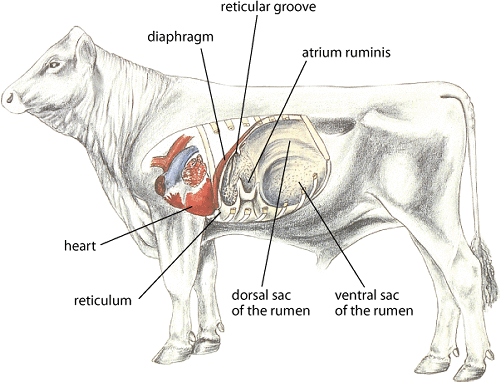
Hardware Disease is a common term for Bovine Traumatic Reticulitis, Bovine Traumatic Reticuloperitonitis, and Bovine Traumatic Gastritis. It’s not so much a disease, but major damage to the stomach wall in cattle caused by the ingestion of metal debris.
It begins when a piece of metal is accidentally eaten by the cow. The metal is collected in the reticulum of the stomach, which catches all of the heavy/dense materials that get consumed. Because the metal cannot be digested, it sits in the reticulum until muscle contractions accidentally force it through the stomach wall, diaphragm, and potentially the heart sac. This obviously causes major damage to the animal, as the sharp metal fragment has now perforated multiple organs.
Cattle affected by Hardware Disease may initially present with bleeding of the oral cavity and throat due to the metal’s sharp edges. Over time, they may experience symptoms of depression, lethargy, weight loss, painful bowel movements, poor appetite, and indigestion. If the heart has been perforated, they may accumulate fluid in the heart due to infection, have fluid in the brisket, and become bloated.
This is a serious diagnosis, but, if caught early, 60-75% of cases can be treated and the animals returned to normal function (according to the University of Missouri). Treatment options consist of constant elevation of the forelimbs for 10-20 days, a surgical incision in the ruminal wall, use of a rumen magnet, or, if its injuries are too extensive, the animal may be euthanized.
Where Does This Metal Come From?
These metal fragments can come from multiple places. They used to be primarily found to come from farm equipment or pastures when cows would unintentionally ingest things like nails or pieces of metal wire. However, once farmers began to practice more careful standards and improve their equipment to lessen the risks, these fragments have found a new avenue.
Now, many of these metal fragments come from… you guessed it: Littering.
Littering has been a worldwide problem for more reasons than I could even detail in one post. When it comes to disposing of trash, many people are not exactly considerate. Where I get passionate about this topic is the fact that not only are these people putting the environment and wildlife at risk, they’re now also endangering other people’s livestock, pets, and livelihoods.
Picture this:
You’re on back country roads, drinking some Coca-Cola, and jamming out to your favorite tunes. Savoring that last sip, you rid yourself of the can and toss it out the window. Out of sight, out of mind. Right?
While it may take you 30 seconds to forget about that can, the farmer who’s hay field it ended up in certainly did not. If they didn’t see your can during baling season and accidentally mixed it into the hay, they’re going to have an injured cow, a hefty vet bill, and possibly have to euthanize it, depending on the severity of the case. Is someone else’s beloved animal worth as little as a five minute trip to the nearest trash can? Is a little bit of short-lived convenience worth so much that it’s reasonable to detriment others to maintain it?
Aren’t Farmers Trying to Prevent It?
This is not a rare occurence. You can tell by the name: Hardware Disease. It’s happened so many times and is so common that they’ve literally given it it’s own name. That’s messed up.
Farmers know how inconsiderate some people can be and have made great strides to prevent this from happening to any more cattle. From magnets on large equipment, to field inspections, and even monitoring and sorting through feed, they are doing the best they can to prevent this horrible outcome. However, they can’t catch everything and some cans and metal debris still get past their best efforts.
But, in reality, why should they have to? They’re not the ones being irresponsible and they certainly shouldn’t be the ones on cleanup duty. That would be like buying cereal for your kids and having to personally sort through it every morning to make sure someone didn’t put something harmful in it. Wouldn’t you rather someone just not put anything harmful in it to begin with?
Nevertheless, farmers are doing their best to prevent it, but they need your help.
How Can I Help?
The best and most helpful thing you can do to prevent the heartache and stress associated with Hardware Disease is to stop littering. You don’t know where your garbage will end up and it’s not fair to the people who have to clean up your mess. Avoid leaving trash behind and throw it out at the nearest trash can, like a responsible adult.
The second best thing you can do is spread the word. Sure, everyone knows that littering is bad, but a lot of people won’t fully understand until they hear the reasons why. They won’t think about the consequences until they know what it does to innocent animals. It’s up to us to educate the public as best we can and try to lessen the prevalence of these situations occurring. No animal deserves this.
Farmers are begging for your help. We need to end littering, not only for the environment, but for the thousands of farm animals who didn’t deserve what happened to them at the expense of a can of Coke. Support local farmers and dispose of your trash properly. The environment, the animals, and the farmers will thank you.
Sending horses to slaughter is one of the singlehandedly most controversial topics in the equine world. Some absolutely despise it, while others view it as a necessary evil.
Something that’s very important to me is my belief that everyone has the right to make their own informed choices. I believe that a person can choose to support or not support any activity or organization that they choose, as long as they make an unbiased effort to learn about it first.
But, sometimes educating yourself about these things can be hard, especially when people or organizations use deceptive methods to try to trick people into supporting them. One in particular that is notorious for manipulating people is the BIGGEST scam in the equine industry: kill pens.
What Are Kill Pens?
Kill pens are where people called “kill buyers” hold their horses. “Kill buyer” is the term dedicated to individuals who buy horses at cheap prices and flip them for more money at slaughtering plants. They’re most commonly seen at low quality auctions and sales where horses are priced lower than meat market value. Overall, the goal of a “kill buyer” is to fill their trailer for the cheapest amount of money so that, upon reaching the slaughtering plant, they can sell each horse for a higher meat value and make a profit. Kill pens serve as the midpoint between the sale and the slaughter.
Kill pens are also the place where these horses can be “rescued” for a price. They’re generally posted online, often on their own Facebook pages and websites, with short descriptions of the horses and their kind, sweet personalities. Now, you’re probably thinking, “who wouldn’t want to rush over and rescue a trailer full of these innocent animals?” Myself and every other educated equestrian… and I’ll tell you why.
Kill pens exploit the generosity and good nature of the general public to make more money slaughtering the same (or higher) amount of horses.
How Does It Work?
“Kill buyers” have contracts with slaughterhouses in other countries, usually Canada or Mexico. These contracts basically state that the “kill buyer” must supply each slaughterhouse with a specific number of horses within the contract period. So, if the contract states that the slaughterhouse needs 72 horses per month, the “kill buyer” is required to buy and transport 72 horses per month to the slaughter facility. That’s just a random number I used as an example. However, note that the American Veterinary Medical Association estimates that approximately 90,000 to 140,000 unwanted horses are shipped to slaughter each year (avma.org).
What Does This Mean Exactly?
It means that no matter how many horses you attempt to save, the exact same amount of horses will go to slaughter. “Kill buyers” are legally obligated to transport their minimum required number of horses to the slaughterhouse, which means in one way or another they will find those 72 horses (again, just an example) and place them in kill pens.
So How Does Rescuing From Kill Pens Tie Into This?
When you “rescue” from a kill pen, they’re profiting off of you. You’re giving them more money and increasing their opportunity. With greater profit comes an increased number and availability of horses they can purchase, an increased ability to buy bigger trailers, and more funding to build bigger and better kill pens. Sure, you’ve saved that one horse, but their spot on that trailer is just going to be filled with another unfortunate horse. Not only that, but it’s likely that they will purchase additional horses to shove on that trailer, since with your dollars they can now afford to do so.
Buying horses from kill pens means rescuing 1 horse at the expense of 10 more.
Let me give you an example:
A “kill buyer” shows up at an auction and buys a horse for $300, intending on selling it for meat.
Now, let’s say the slaughtering plant offers him $600. This would be the meat value. If he were to take it to the slaughtering plant, he would make a profit of $300.
He then decides, in an effort to raise his profits, that he’s going to advertise to the public that this horse can be saved from slaughter for a marked-up price of $900. He also makes sure to write that it only has a week left to live until it’s shipping date, in order to create a sense of urgency. The man sends the horse’s photo to numerous rescue groups and, in a short amount of time, the word spreads like wildfire. They give it a name, a personality, and a sad backstory, all things that personify this horse and make it pull at the heartstrings of the public. He’s got people all over the area raising $900 to save the horse and some even checking his property to see if others can be saved as well.
In as little as a week, he’s “allowed that horse to be rescued” for $300 more than what the slaughtering plant was going to give him, doubling his profit and possibly selling other horses the same way in the meantime.
Assuming he decides to use all of the “rescue” money, he now can afford to purchase 3 more horses to either continue the cycle or actually send to slaughter.
But the deception doesn’t end there.
Not only are these horses being used to make a quick profit, a lot of them won’t even be shipped to slaughter anyways! Due to the public’s consistent rapid response to helping these horses in need, the “kill buyers” have realized that they don’t have to stick to horses that they can purchase under meat price. They’ve learned that they can purchase ANY cheap horse, mark up the price, and the public will pay it without question.
Here’s another example:
A 26 year old skinny, untrained gelding with leg injuries that make it unsuitable for riding runs through the auction floor. This is an older horse that has no training and will only be able to sit in pasture for the rest of its life.
The regular market price for this horse is, say, $500.
Since the owners disclose this information to the auction, nobody is interested in bidding except the “kill buyer”, who bids $400.
Now, because the horse is thin, the slaughtering plant will only give them $200. This would mean a loss in profit.
However, this horse was never meant for the auction.
The “kill buyer” takes this horse to the kill pen and immediately posts it online for $1,200 with an impending shipping date. You saw that correctly, a shipping date. But, they didn’t say to the slaughtering facility. If they cannot find a horse lover to deceive, they will simply take the horse back to auction and hope it sells for more than their original bid: $400.
You see, not only did the horse never actually end up going to slaughter, but if it was “rescued”, the rescuer would’ve paid much more than market price for a horse that potentially could end up being euthanized anyways, depending on its injuries. And that’s another thing. If a “kill buyer” lists a horse with incorrect information, nobody bats an eye because “at least the horse was rescued from slaughter, right?” That 26 year old horse could have been listed as a healthy, but thin 13 year old and the public isn’t even going to do a veterinary check until after the horse is purchased. And if they do get mad about it, what are they going to do, take him back?
Furthermore, many kill pen horses are illegal to ship to slaughter in the first place.
The American Veterinary Medical Association states, “Under current regulations, horses are not eligible for transport to slaughter unless they are able to bear weight on all four limbs; able to walk unassisted; able to see out of at least one eye; are older than 6 months; and, if pregnant, are not likely to give birth during the trip” (avma.org). Any horses that don’t fit these requirements are not eligible to be transported to slaughter.
If you find yourself on a kill pen page, you’ll see that some of the horses that are posted with a shipping date are illegal to be sent to slaughter at all! The horses offered to the public are NOT the horses going to slaughter, they’re a SURPLUS bought by the “kill buyer” to make a larger profit. You, as a horse lover, are funding his operation.
When you buy from a kill pen, you are paying the “kill buyer” to lie to you and giving him the money to do it to others as well.
So What Does This Look Like?
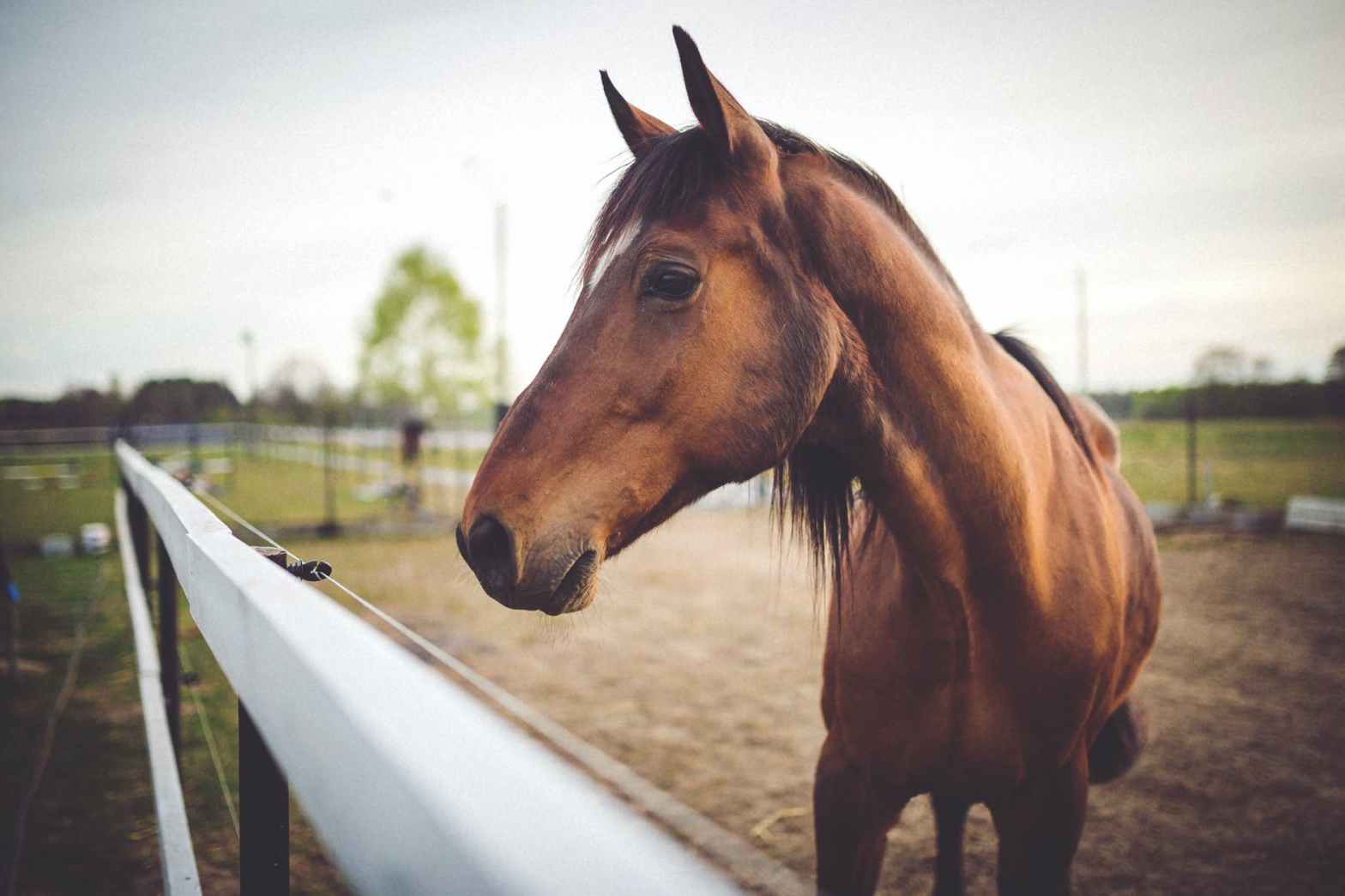
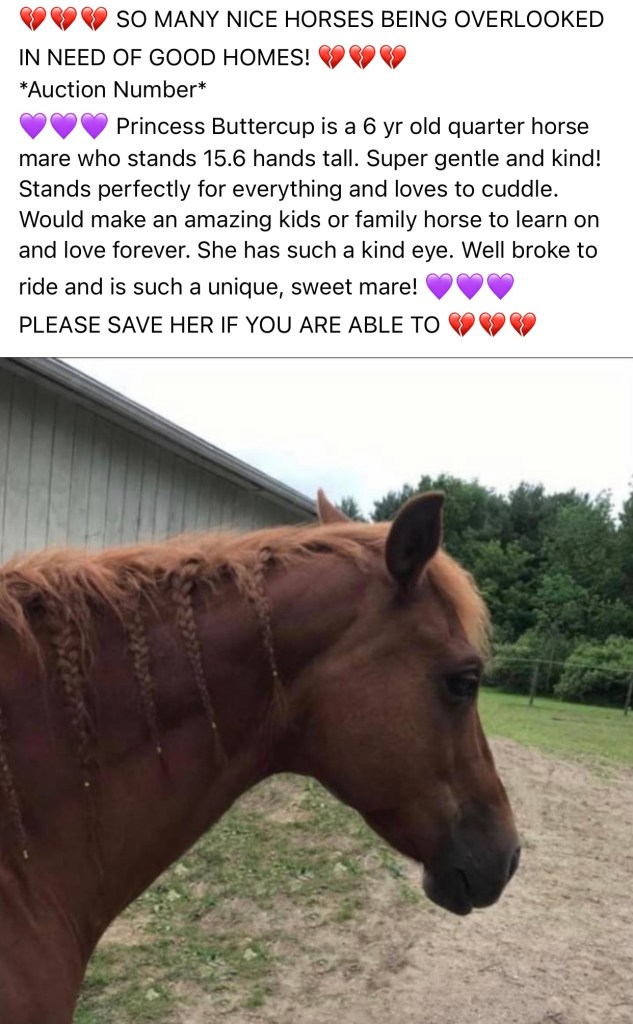
I’m not sure about the legality of posting specific photos and advertisements from the kill pens themselves on the internet, so I’ve made my own to show you (with Chicken as my model, of course). This is fake. However, it mirrors the type of posts that I see day and day again from kill pens on Facebook.
A few things I want you to notice in this ad are the obsessively positive descriptions of this horse and no (or very few) mentions of any negative traits or vices. Non-manipulative sale ads don’t look like this. First of all, the name Princess Buttercup screams “I’m adorable, please buy me for your child.” A lot of the horses posted always have cutesy or tacky names. There are some that might not, but that’s just for the purpose of adding variety to make sure people don’t catch on. 53 horses in a row with the name “Princess Buttercup” would be more than a little suspicious.
The heart emoticons and overly “lovey” descriptions sway you into feeling bad enough for the animal that you’re more willing to rescue it, regardless of the price. Not to mention, due to Facebook’s ban on animal sales, any and all posts with prices get taken down. This is where it gets even trickier, because once you go out of your way to message the page for the price list, they’re able to send you messages that may inflict guilt if you back out. The more you interact with these pages, the more they lay on the act that they want what’s best for the horses (but they don’t, they’re the ones sending them to slaughter in the first place).
This ad also has no mention of any real horse traits. Sure, they have the basics: age, breed, and height. However, they don’t include any tangible information about why the horse is perfect for families, why it’s considered a child’s horse, or what training it has (in detail). They don’t really go into detail about… well… anything. This is because the ad is fake and there’s no way for them to know any of these things, even if they were real. For comparison, look up some real horse sale ads and tell me how many of them don’t mention anything about whether the horse rides English or western. Real ads are full of information and details about all aspects of the horses’ lives, which is the exact opposite of what you’ll find in kill pen ads.
Every genuine person wants to provide the best life they can for their horse, which entails telling potential buyers all about their personality, quirks, training, and specific care needs. This is especially true for rescues, who work tirelessly to put together the perfect match between horse and owner. If it’s shortened into one brief, sappy paragraph, chances are good it’s not real.
Next, let’s analyze the photo. Kill pens often post close-up photos where the horses look more sweet and personable. Sometimes they even look slightly sad. Don’t be fooled, this is intentional. These photos are specifically chosen to elicit a response from the viewer. You can see my example photo of Chicken follows along these lines, even though she’s my healthy, well cared for, personal horse. Sure, the horses obviously aren’t jumping with joy to be in a kill pen, but their photos and unfortunate circumstances are so highly exaggerated that the only person it benefits is the “kill buyer”. The pages have learned that they get a larger outreach from the community if their photos match the emotional tone of the rest of the ad. If they were to show happy, alert horses, their sad and sappy captions wouldn’t make sense.
Overall, kill pen ads will have very noticeable overwhelming positivity about the horse, a never ending list of sappy stories, and a massive lack of detail overall. Remember, if it makes you feel a strong sense of sadness or guilt: you’re being manipulated.
Wait, wait, wait… But Isn’t Your Horse a Kill Pen Horse?
No.
I rescued Chicken before she had a chance to get to a kill pen. She was never in the hands of a “kill buyer”. I made a deal with the previous owner and spared her from that path entirely.
However, this is not something I would recommend for everyone, which leads me to my next topic.
If Rescuing From Kill Pens Hurts Horses, How Can I Help?
There are many ways to help horses that don’t include being manipulated into funding the kill pens.
Support Your Favorite Rescue!
If you have a credible horse rescue local to you, you have a lot of different options! You can sign up to volunteer your time helping around the barn, drop off helpful/needed items, or even make monetary donations towards vet bills and other rescue expenses. If you have a specific skill or ability, you could even help them with more specialized needs, such as electrical work or basic construction. Local rescues are grateful for any help they can get, so don’t be afraid to speak up if you have unique ideas that could help them care for their animals. If you can’t find a local horse rescue, you can always search for a quality one online and make donations through their website. Not only will you actually be helping horses, but you won’t be putting any more in harms way.
Just make sure they don’t find their rescues through kill pens. Their good intentions might be to help horses, but there are still a lot of people who are deceived.
Rescue From Real Rescues
Even though kill pens are deceptive, there are still honest ways to rescue horses. Visiting and adopting from local, credible rescues not only insures that you’re actually helping horses as a whole, but also protects you from unforeseen circumstances and uncertainties. Rescues want to match the perfect horse and owner, which means they’re extremely unlikely to give you false information about the animal. You’ll have an accurate age, general behavior, and often times some amount of training. They will even have accurate medical records, since every horse receives a veterinary exam upon arrival to the rescue. Best of all, a lot of their horses come from owner relinquishes and abuse/neglect cases, so saving that one horse doesn’t automatically put others at risk.
Again, just make sure their horses don’t come from kill pens.
Don’t Participate in Kill Pen Rescue Fundraisers
Listen to me, I know you see that cute little face on their Facebook, and I know you want to send money to help save it. Don’t.
I know it’s hard, but “rescuing” that one will only lead to many more cute little faces ending up in the same position. Don’t share these posts, don’t send money to these posts, and definitely don’t help advertise these posts. By decreasing the attention that these posts get, you’re preventing more people from being manipulated by the same tactics and falling into the scam.
Spread The Word
One of the best and easiest things you can do to stop this deception is to educate your peers and acquaintances about it. Talk not only to the horse owners and riders in your life, but also to horse-loving friends and relatives as well. While it’s true they may not be actively rescuing horses in their free time, you never know who’s unknowingly donating to kill pen rescues and fundraisers behind closed doors.
When you do this, it’s likely that you’ll experience some disbelief and pushback. People have a hard time watching horses be sentenced to slaughter. I get it, I really do. But these “kill buyers” are merely pulling on their heartstrings and manipulating them. It’s not fair to the people who genuinely think they’re helping a good cause. They’re donating their hard earned money to what they think is rescuing a living creature, but not realizing that they’re accidentally supporting the slaughter industry that they’re so against.
If you don’t feel confident enough to have this conversation with them, you’re absolutely welcome to send them this post! There’s also thousands of other articles that cover this topic right at your fingertips (via the internet). Spread the word however you’re comfortable, as long as people are getting the message.
*If you’d like to read more about this topic, here are two links that I really recommend looking into:
Click Here to read an article by a woman named Libery Valence, someone who used to personally buy from kill pens in the past. This is one of the most thorough explanations I’ve found so far and I especially like her easy-to-understand comparison of kill pens to puppy mills.
I wish there were more organizations that have spoken out about this, but unfortunately a lot of the equine world is still being manipulated. Those that do know about this also may not have the platform to be able to publicly detail their thoughts. I’m hoping that by joining the efforts to expose this scam, more people will become aware of it.
The scam needs to stop, and you can help.
How Is This Going To Make a Difference?
I know what you’re thinking, “is avoiding kill pens really going to make a big enough difference?” The answer, in the long run, is yes.
If you haven’t figured it out by now, kill pens are a business. And what happens to businesses that don’t sell their inventory? They fail. It’s going to take a lot of learning and education to get there, but as soon as the public as a whole stops rescuing from and accidentally supporting the kill pens, their existence will dwindle off. If we, as educated members of the community, refuse to support their scam, they will eventually be forced out of the industry with very little funds to continue.
The more people “rescue” from kill pens, the more money they’re making and the larger and more prevalent the problem gets. That’s why it’s extremely important that we educate ourselves and those around us. By refusing to buy horses from the kill pens, less horses will be purchased from auctions by these people and fewer will have to go through the same situations.
Kill buyers want you to feel sorry for their animals. They want you to see that cute face, sweet personality, and rush to their rescue. If they didn’t, they surely wouldn’t allow their animals to become publicized and would make every effort to remain in seclusion. They’ve caught on to the fact that they can trick these well-meaning animal lovers into accidentally supporting them, and this is a major way that they’re making bigger profits. Kill pens are a scam, and the majority of the horse world is falling for it.
There are many ways to help rescue animals, but giving money to a kill buyer only sentences more of them to the same fate.
“There are two ways to be fooled. One is to believe what isn’t true; the other is to refuse to believe what is true.”
Nearly everyone that has ever used the internet has seen a cute video of an animal online and thought, “That’s so cute, I should get one!”
Out of all of these people, a percentage of them will actually try to purchase said animal… and most of that percentage will fail. Why? Poor planning and lack of preparation.
Most people will have the urge to buy an animal at one point or another in their lives. Some act on impulses and jump face first into animal ownership, while others put reason first and follow through.
So what should you do when thinking of adding an animal to the household?
Why Do You Want This Animal?
Firstly, consider what attracts you towards this animal.
Is it cute? Is it fluffy? Do you just want to pet and play with it?
If you answered yes to any of these, and see them as your main reasoning, you probably should not purchase this animal. These traits are typical of people in a phase that will enjoy the animal in the short-term, but struggle to continue enjoying the company of the animal in the long-term. They may buy a dog in the cute puppy phase, then find it boring when the dog gets older and isn’t as playful. If you think you may be one of these people, owning this animal might not be for you. You would likely be happier in the long term if you find a friend who owns a similar animal and visit when you catch yourself with a case of “animal fever”.
Now, do you want this animal because you think it would be a great long-term addition to the family? If livestock, does it serve a purpose? Would it be beneficial to your homestead or family farm?
If the answer to any of these is yes, you’re in this for the right reasons. Animals should be carefully considered before any thoughts of purchasing them and by setting realistic expectations, you’re thinking in the long-term. Thinking in the long-term is important because it stops impulse purchases and instead forces you to have a plan for how this animal is going to fit into your life.
Research, Research, Research!
If you’ve determined that purchasing this animal is right for you, the next step is to do vast research on all aspect of the animal’s needs and care. I know that’s quite a general statement, but don’t worry! I made a list to start you off.
Things To Know
Diet
What does the animal eat?
How often does it need to eat?
Do you live in a location where this food is plentiful?
Will it need any supplementation?
Does its stage of life require excess nutrients?
Daily Care
What does this animal’s daily care look like?
Is it very hands-on (like horses)?
Is it able to be left alone for longer periods of time (like fish)?
How involved do you need to be with the animal each day?
How will this animal fit in with the animals you may already currently own?
Will this animal’s needs fit into your daily schedule?
How do other people that own this animal view the impact to their lifestyle?
What happens if this animal does not get the adequate care it needs?
Equipment
Will you need any specific equipment to keep/handle the animal?
Will you need separate transport for the animal, such as a trailer or crate?
How often, if at all, will this equipment need to be replaced or repaired?
Breed Quirks
What are the traits of each breed?
Will the chosen breed fit with your lifestyle?
How does it differ from other breeds in care, nutrition, health, and handling?
What do people who own this breed say about it?
Possible Health Problems & Signs to Watch Out For
What health problems is the animal susceptible to?
How common are each of these problems?
What are the common treatments for them?
How much does this typically cost?
What are symptoms the animal can display that indicate a health problem?
What behaviors are considered abnormal?
Location
Do you live where owning this animal is common?
Are you close to other people who are knowledgeable about this animal?
Will your location make it easier/harder to care for the animal?
Are there adequate veterinarians that will treat the animal in your area?
Average Monthly/Yearly Costs
How much should you expect to spend on this animal monthly?
How much will you spend yearly?
Are there any annual costs? (veterinary checks, vaccinations, etc.)
Are there any situations that could increase these costs?
Professionals
What type of professionals will you need?
Will the animal need to see a farrier/chiropractor/dentist/etc.?
If so, how often will visits with these professionals need to be made?
What type of veterinarian will see the animal?
Will the veterinarian come to your house or will you take the animal to the clinic?
Overall
Do you have the monetary, physical, and emotional capabilities to care for this animal?
These are just some general questions to get you started on your research. If you happen to come across other relevant topics in the meantime, I 100% recommend looking into those as well. The more prepared you are, the easier and more enjoyable animal ownership is going to be.
I know it seems like a lot. Trust me, I do. I’ve done this research myself on every single new breed and species of animal that I’ve added to my farm. That’s why I know from experience that you will be much happier and less stressed figuring out all of this beforehand rather than jumping into it and inadvertently putting the safety and wellbeing of the animal at stake. By doing prior research, you will be able to avoid common mistakes and failures that others may experience and save yourself a lot of time, money, and frustration in the long run.
Setting Up For Success
Now, assuming that you’re still interested in purchasing the animal, it’s time to set yourself up for success! There are a few things you can do as a new/potential owner that can make your life a whole lot easier.
Yearly Management Calendar
For owners new to the animal or breed, I highly recommend making yourself a yearly calendar for at least the first few years (I still use mine). Include everything from your research and set dates accordingly.
For example, for a dog management calendar, you would add yearly veterinary checks, when vaccines will be scheduled, monthly nail trimming and grooming needs, and any other services you may need for your dog that year.
For a horse management calendar, you would pencil in yearly veterinary checks, dental work appointments, yearly vaccinations, deworming schedules (seasonally/annually), and farrier appointments, among other monthly and yearly needs.
Not only does this hold you accountable to get all of these things taken care of, but by putting everything into a calendar, you won’t have to worry about what you might be forgetting. Everything that needs to take place will be detailed and listed on the day it’s scheduled, which will give you the comfort of knowing that as long as you follow the calendar, these needs will be met.
I know that life happens and some activities might not always be able to happen on the day they were written in, but it’s always good to have a rough outline to follow, especially being new to ownership.
There are many different methods and platforms that will allow you to create a productive management calendar. I personally prefer to use the calendar app that comes pre-downloaded onto my iPhone. I create a separate calendar from my non-management events and set reminders to whenever I would like to be reminded about the appointment or activity. Another plus is that you can customize each event to repeat whenever you’d like, meaning you only have to physically type it in once and can set it to reoccur over specific periods of time. The only downside is that you can’t share your calendar to another person if you need to. They have to make their own. However, Google Calendar will allow you to share calendars between accounts, so that may be an option for you. And if you’re not very techy, physical calendars will work just fine.
Service Book
This is something that not a lot of people do, but nevertheless something I think is extremely beneficial to new owners.
Have you ever pushed something off because you didn’t know how to do it? Have you ever procrastinated something because you’re not sure who would be able to help?
A service book is really helpful in preventing the “I was going to get this done, but I didn’t know who to call” scenario. It lessens the likelihood that you will push something off or procrastinate it due to lack of knowledge on what to do to solve the problem.
What I recommend, when making this book, is writing down every service that you might need at one point or another in the animal’s life. This includes any veterinarians, emergency care centers, dental care specialists, hoof care experts (if applicable), reproductive specialists (if applicable), and any other professionals or specialists you may require the use of at some point. This isn’t to say that you’ll need them all, but it’s helpful to be covered in various different unexpected situations.
Next, find two to three service providers or centers that handle each service. This is the time to ask for recommendations! As someone who has worked with animals for over a decade, it’s much easier to have your ducks in a row during a crisis than spend an hour waiting for your friends to respond with which vet they prefer. Sometimes you don’t have the time, and having a collection of businesses and phone numbers at your fingertips can make any situation go a lot more smoothly.
*If combined with the yearly management calendar, getting things done can be as simple as checking your schedule and flipping to the corresponding page in your service book. It’s really that simple!*
Animals are a lifelong commitment. Impulse buys, while fun for the owner at first, are unfair to the animal and put them in harms way when care is unintentionally suboptimal and the “cute phase” begins to fade. By using these research and planning tips, you can greatly reduce the possibility of unfavorable situations, wasted time and funds, and unnecessary stress and become the responsible and prepared owner an animal needs to thrive.
Chicken keeping is one of the most financially misunderstood types of farming. Many people believe that all a chicken farmer has to do is throw some seeds to their flock and reap the profits.
However, that couldn’t be more inaccurate.
Chicken farming is financially difficult to plan with high start up costs and little room for monetary flexibility. With the rise of individuals buying into this hobby thinking they can make a quick buck and consumers avoiding local prices in favor of chain stores, many first-timers are doomed to fail. This is why I feel it’s so important that I shed some light on the reality of what it takes to own chickens, so those on a tighter budget don’t fall into the same trap.
Let’s dive into the reality of owning backyard chickens, shall we?
For the sake of numbers, we’re going to look at an averagely managed flock of 30 hens. This is the size I normally raise with the calculations and costs that I’m most familiar with, so I feel like it would be the most accurate example.
*All prices were averaged from my local Tractor Supply Co. Other areas may vary.*
Up Front Costs
Housing
The cost of housing depends entirely on the materials and knowledge available to the individual. Those with access to basic materials and the construction knowledge to turn them into a suitable coop will have a much lower cost than someone who may buy a pre-built shed. On the low end, this could mean $400. On the high end? Thousands. Either way, structures suitable for housing chickens aren’t exactly cheap.
Fencing
Fencing is the second most expensive aspect to chicken keeping. Those with bigger runs may even argue that it’s the first. A single 50 ft section of fencing, depending on the type and style, runs anywhere between $25-$120. Most individuals will need multiple rolls to complete their setup and the ones who choose cheaper rolls will likely need to replace it more often. In a decent sized area, this adds up quick!
Feeders: $25 for 30 lbs feeder
Feeders are not as expensive as housing and fencing, but are still an important start up cost. For a flock of 30 hens, a 7, 10, or 15, lbs feeder will empty too quickly to be worth purchasing. 30 lbs is a much more adequate feeder size and can be found at Tractor Supply Co. for $25.
Waterers: $40 for 5 gal (or $50 for heated 3 gal)
30 hens are going to drink a lot of water, especially in the summer. A 5 gallon waterer from Tractor Supply Co. costs approximately $40 and holds enough water to last multiple days. However, a heated waterer will also be needed to keep the water from freezing in the winter months, which can be found for $50 with a capacity of 3 gallons. Together these cost about $90.
Heat Lamps: $5 bulb & $10 lamp
Heat lamps are one of the cheaper pieces of equipment to purchase. A lamp can be found for $10 and used with a $5 bulb. These will usually last a while and rarely need to be replaced, unless used too consistently or broken.
Hens
At most hatcheries, sorted pullets of common breeds will cost $3-$4 per bird. For 30 chicks, this equals out to about $100 altogether.
Average Total Start Up Costs (minus housing & fencing): $230
This total does not reflect any costs associated with housing or fencing. Each individual will have a vasty different scenario and I feel that it’s way too variable to estimate. That being said, it would be completely possible for this number to jump to $1,230 or even $5,230 with those costs added back in.
Continuous Costs
Bedding: $6 per bag of shavings
Depending on the size of the coop, most people will use 1-2 bags of bedding each time the coop is cleaned. Assuming it’s cleaned at least once per month, it will cost an average of $6-$12 per month.
Feed: $15 per 50 lbs bag of layer pellets (average)
30 hens will go through roughly one bag per week in chicken feed, especially if their ability to free range is limited. In a month, this would equal out to 4 bags of feed for a total of $60.
Electricity
The additional cost to the electricity bill can vary between households and fluctuates depending on the time of year and stage of life that the chickens are in. For example, electricity usage often goes up in winter with the use of heated waterers. It also increases when unfeathered chicks require the use of heat lamps in the early stages of life. With different households and needs, it’s hard to create a rough cost estimate, but it’s still important to think about when raising chickens.
Water
Water bills and usage depend not only on time of year, but also relation to the city. It’s no secret that animals will drink more water in the summer months to stay hydrated. However, households that are tied into city lines will have to pay for that extra water usage, whereas those with wells may be able to avoid the bills completely. With the additional cost being extremely varied between households, a rough estimate is hard to create. However, it’s still good to consider when adding up expenses.
Average Costs (minus water & electricity): $72 monthly / $864 yearly
These costs don’t include any increase in bills for water and electricity. Both amenities vary between households and can fluctuate depending on the time of year and the stage of life that the chickens are in. For these reasons, it’s entirely possible and likely that adding those costs back in will lead to an increase above $72 per month.
Emergency Costs
Fence Repairs
Remember the numbers up above where we talked about putting fencing up in the first place? Good. Add at least half of that cost if part of the fence collapses and double that cost if the entire thing needs to be replaced.
Birds lost to predators: $$$!
Sometimes the unthinkable happens and a predator takes off with some of the hens. Not only is it extremely upsetting for the chicken keeper, but it also puts them hundreds of dollars back from where they were before. They have to start all over with new chicks, if there’s no survivors, and go back to using their heat lamps and purchasing chick starter/grower. Not to mention, they also lose at least 6 months of production until the chicks are old enough to lay eggs. A few predator attacks can be the difference between business as usual and a $600 set back.
Medical Supplies
In any scenario, chickens are likely to need medical attention at some point. Products such as antibacterial spray, mite treatment, electrolytes, and other preventative supplies are key to keeping the flock in good condition. Without them, chickens may become unhealthy and stressed, leading to a decrease in both the quality and quantity of eggs they produce. If prolonged stress or suffering occurs, it can quickly turn lethal.
Broken Equipment
The standard lifetime of most chicken equipment tends to be a few years. Exposure to weather, daily wear and tear, and birds knocking it around can really take a toll on its condition. Every couple of years, expect to replace at least some of your feeders, waterers, or heat lamps.
Egg Sales
“But, you make a lot of money selling eggs… right?”
Not exactly.
A good egg-laying breed will lay approximately 5-6 eggs per week. A flock of 30 hens at peak performance would likely produce 150-180 eggs, or 12-15 dozen, per week. In total, that would equal 48-60 dozen per month.
However, that isn’t exactly realistic. The laying frequency of hens can be affected by a variety of different situations. Changes in weather, temperature, feed quality and consumption, water intake, light changes, parasite infestation, disease, molting, and stress can all decrease the amount of eggs a hen will lay in a week.
Due to this, and assuming the hens will never be in a completely perfect environment, we’ll use the lower number in the range (150 eggs per week).
So how much can you make selling 48 dozen eggs per month? Not a lot.
The general consumer that shops at local stores, such as Walmart, has access to a dozen eggs sold for roughly $1.50 or less, depending on the time of year. Any chicken owner that tries to compete with chain stores and matches that price will bring in $72: the exact monthly cost it takes to feed and care for their hens (disregarding water and electricity). This turns $0 in profit and does absolutely nothing to make up for the high start-up costs that the farmer paid for in the first place, nor the work continuously put into their upkeep.
Now, a higher price of $2.50 per dozen would bring in $120 per month: a $48 profit. This is obviously better than attempting to match chain store prices, but is still minimal reward for hard work. Picture it this way, how would you feel working every day for $12 a week? Even at one hour per day, that would be an hourly profit of $1.71. And if anything happens to the hens? There’s only $48 to spend on medication, replacements, and equipment that month before the farmer is dipping back into their own pockets. If a waterer breaks and needs to be replaced? That leaves $8 to spend for the rest of the entire month.
And trust me, there’s always something going awry when you own livestock.
Now, for the sake of this example, let’s pretend that the farmer never needs to purchase anything extra and keeps the $48 of profit every single month. If their starting cost was $3,000 worth of fencing and materials, it would still take them over 5 years to break even. But that would mean buying absolutely nothing extra every month and never having to treat the hens for any illnesses, which is nothing more than unrealistic wishful thinking.
Overall, chicken keeping is not as profitable an endeavor as it may seem. High feed and equipment costs drive farmers to raise their prices in order to attempt to break even, which in turn drives away consumers who prefer to purchase cheaper eggs from chain stores. With a lack of funding for continuing the flock, many hobbyists looking for quick monetary opportunities experience unexpected financial hardships and drop out of the industry altogether. In short, chicken keeping can be brutal when viewed solely as a financial decision.
That being said, chickens are a wonderful addition to farm life. I currently have a flock of 35, myself. They bring farm fresh eggs right to the backyard and are an amazing learning experience for those interested in country living. However, they’re only beneficial if you have a passion for them in the first place.
The only people that benefit from owning chickens are the people that do it because they love chickens, not because they want to make a quick buck.
I hope I was able to shed some light on the reality of raising backyard chickens and how important it is to consider all costs when deciding if they’re right for you. And for consumers, I hope you now understand that the local farmer doesn’t want to charge you an arm and a leg for their products. They’re not trying to scam you. They just have to charge a high enough price to survive.
Supplements are a staple for horses of any age, breed, and size. Although many people worldwide have grown to appreciate them for their amazing benefits, they tend to get a bad reputation by people who may not know a lot about equine nutrition. Supplements are extremely beneficial to not only the horse, but the owner as well, and are key to keeping the equine in their best condition.
Here’s a list of five benefits of supplements in the equine diet:
Happy, Healthy Animals
Minerals are essential in creating a healthy equine diet. Horses need a specific balance of each mineral to be performing at their best and when one is lacking, they’re not able to reach their full potential. This can result in decreased performance, abnormal behavior, and even poor health. When supplements are given, they work in correlation with the other aspects of the diet to ensure that the horse is getting exactly what they need to be able to thrive, resulting in happier, healthier animals all around.
Minerals not only keep the horse healthy, but they also prevent problems caused by deficiencies. Deficiencies are a lack of one or more nutrients in the body caused by a nutritionally insufficient diet. Without a proper balance of minerals, issues will arise that can negatively impact a horse’s health. A few of the common deficiencies include salt, phosphorous, potassium, magnesium, and zinc, among other minerals. These deficiencies, over time, can wreak havoc on a horse’s ability to thrive.
For example, a salt deficiency may cause dehydration and muscle spasms. That may not seem like a major problem, but these symptoms can lead to decreased performance and the inability to exercise comfortably.
On another level, a zinc deficiency is much more detrimental. Horses with zinc deficiencies may experience dull coat, poor hoof condition, and bone diseases, among other symptoms. This can greatly affect their ability to live comfortably, especially because they spend the majority of their lives putting such a large amount of weight on their hooves.
If that doesn’t scare you, some mineral deficiencies can even cause symptoms such as night blindness, reproductive failure, and neurological issues!
All of these symptoms can cause the animal great discomfort, which is why it’s so important to prevent them in the first place.
Decreased Food Consumption
Another benefit of providing mineral supplements is that a well supplemented horse will generally eat less hay. Horses are continuous grazers and will continue to eat all day long to get the amount of nutrients that they need. By providing minerals, the horse will have easier access to those nutrients and will be less inclined to seek them out in the form of overeating. In other words, they won’t have to eat as much hay to get the same amount of nutrients. This can be extremely beneficial for someone who wants to slow hay consumption, yet still keep their horse on track nutritionally.
Say Goodbye to Hay Belly
While not the worst condition, hay belly can still be problematic. Hay belly is the term for a horse’s protruded stomach after eating large amounts of low quality hay and is indicative of a nutritionally insufficient diet. It’s rarely a major cause for concern, but can cause issues when saddling up if the girth is too tight and, in some cases, can be a cause for deducted points in the show ring. Nutritional supplements, such as protein supplements, can assist in the prevention of hay belly by limiting the horse’s desire to overeat, therefore reducing the amount of hay consumed that ends up in the gut.
Save Money!
One of the biggest and most favorable benefits is… you guessed it: saving money! When you cut corners with nutrition, a lot of things can go wrong. From deficiencies, to decreased ability to perform, to increased feed consumption, each of these cost the owner large amounts of money.
For example, let’s take a look at a horse with a long term zinc deficiency. Since zinc affects the hooves, and horses with zinc deficiencies often have poor hoof health, the horse will likely need intervention to keep its feet in comfortable condition. It may experience more hoof abscesses, contract persistent thrush, and have to undergo treatment for cracked hooves, all conditions that cause great discomfort and become very costly very quickly. In more severe cases, the horse may require hoof protection, such as specialized shoes or cushioning adhesive, which routinely bring extremely large expenses and often require professionals to use correctly. In addition to treatment, the horse will likely need more days of rest in order to keep them comfortable, which limits how much exercise they can do. This can put a strain on the rider, the horse’s training, and individuals who depend on their horse’s performance to generate enough funds to cover their care, such as lesson barns and those who compete at higher levels.
Now, imagine the horse is supplemented with the proper amount of zinc to avoid that deficiency. The hooves are prevented from deteriorating, no extra care in needed in their upkeep, and the horse lives a comfortable and happy life being exercised and cared for as normal. Think about just how many costs are excluded from the situation, plus the satisfaction of knowing the horse is comfortable and healthy. The owner avoids paying specialists for advanced hoof care, doesn’t need to purchase the expensive solutions and treatments for the condition, and enjoys the financial and moral benefits of a healthy animal. It’s a win-win!
Overall, supplements play an important role in maintaining lower expenses without cutting corners on a horse’s health.
Supplements benefit the horse and owner in a variety of different ways. From increasing health, to illness and injury prevention, to saving money through feed reduction, they’re an extremely beneficial addition to a horse’s diet and should be taken into great consideration when creating the ideal nutrition plan for any horse.
A horse’s diet is the most important pathway to its health. A bad diet can cause a host of issues, such as laminitis, founder, obesity, and joint deterioration, whereas a good one will help prevent each of those things and allow the horse to thrive. Moreover, a good diet for one horse might be a bad diet for another.
So, how do you decide which diet is best for your horse?
While I wish I could say the answer is simple, it’s not. However, as an experienced horse owner, I can give you some tips on the steps it takes to figure it out.
I’m going to assume that you know the basic components of what a horse eats, but if not, you can read about that here: Horse Diets for Dummies.
First things first, you’re going to want to take a look at your current situation.
Is your horse stalled for most of the day? Do you have pasture available? If so, how big is it? Is it big enough to sustain the amount of horses you plan to put on it?
Horses must have food available every 4 hours at minimum. If your horse is stalled for any length of time, they’re going to need significantly more hay than horses that have constant access to pasture because they’ll have no other source of consistent forage.
This also goes for horses with access to smaller pastures versus larger ones. Smaller pastures may not be able to provide the sheer volume of forage needed to sustain a horse, whereas a larger pasture might have that capability. The general consensus is typically to allocate two acres for the first horse and add an acre for each additional horse placed on the property, which helps ensure that an adequate amount of forage can be provided by the pasture. However, smaller areas can certainly be used with more careful and precise management.
Overall, your current setup and pasture availability will be the baseline for how the other aspects of your diet planning fit together.
Next, assuming your horse will have access to some sort of pasture, what types of plants are they composed of? Are they weeds? Do you have a lot of typical horse forages like alfalfa and clover?
Pastures filled with weeds won’t sustain a horse nearly as well as those without weeds, no matter how many plants are in them. Think about it this way. A pasture full of weeds is like a fridge partially stocked with plastic toy foods. Sure, it might look full to someone who doesn’t quite know what they’re looking for, but ultimately most of it is inedible. That’s why it’s important to be certain that the plants in your pastures are forages that your horse can actually eat.
It’s also important to determine the type of plants and grasses that you’re growing to ensure that they’re safe to consume in the first place. Certain pasture plants produce mycotoxins, which cause adverse effects when eaten and can lead to immunosuppression, organ damage, colic, abortion, and even death. By cataloging which plants your pasture is growing, these serious implications can be prevented and even avoided completely with close pasture management.
In addition to safety, keeping track of pasture content and quality is also essential in the nutritional aspect of dietary planning. Each forage has a different nutrient content and, if you know relatively which minerals they’re getting the most of, it’ll be easier to balance out in the other components. For example, some areas grow plants that have higher concentrations of zinc. Horses on these pastures typically won’t need as much zinc supplemented in other components of the diet, especially compared to horses in zinc deficient areas. It also works in reverse. Horses in deficient areas will likely need increased supplementation in other components to make up for what their pastures may be lacking. If you don’t know what your horse is eating, they may be missing out on some key minerals and limiting their performance.
If you decide that your pastures are sufficient, congrats! You might not need hay. However, the majority of horse owners do, which is why being able to tell which hay is good horse hay is critical.
Good horse hay is hay that is fresh, soft, not dusty, and hasn’t been exposed to the elements. Any hay that is marked as “cattle hay” or “goat hay” should never be fed to horses, because it may contain irritants that could potentially harm them.
There are many different types of hay, with each fully dependent on the composition of the field where it was baled. Legume hays are mainly composed of either alfalfa, clover, lespedeza, birdsfoot trefoil, or peanut hay. These forages tend to have a higher concentration of protein and calories than other hay types. Grass hays are composed of either warm or cool season grasses and usually contain timothy, orchardgrass, ryegrass, fescue, redtop, reed canary grass, wheat grass, bluestem, bermuda grass, brome grass, or teff. They tend to be lower in calories and protein than legume hays, but higher in fiber. Mixed hays are when some of these legumes and grasses are planted and baled together, which can be done to make certain plants more palatable or change the nutrient ratio depending on the needs of the area. Different geographic areas grow different types of hays, which is why it’s important to research which types are popularly grown in your area.
There are also different cuttings of hay, with each having different nutrient contents. The cutting number is just how late into the season the hay was harvested. First cutting was harvested first, second cutting was harvested after first cutting, and so on.
To go into depth on the differences between cuttings, let’s compare a typical bale of mixed hay:
First Cutting
First cutting is generally less nutritious than second and third cutting. Being the first cutting of the season, it contains more grass and less legumes, such as alfalfa and clover, which increases the fiber content and lowers the amount of calories. The large proportion of grass makes it appear more “stemmy” than other cuttings and gives it a more dull yellow/brown color. However, it’s often cheaper than other cuttings, which makes it a decent alternative that many horses can still thrive on.
Second Cutting
Second cutting is generally the most popular choice to feed to horses. It contains a healthy level of legumes, more so than first cutting, and tends to be very green, leafy, and easy for them to eat. It’s not as rich as third cutting, which still makes it an option for horses more prone to metabolic issues (although first cutting for them would be ideal). The color of second cutting hay is usually more green than first cutting, but less than third cutting. Overall, it’s a very good forage for the average horse.
Third Cutting
Many farmers will not get a third cutting each season, which can make it a little bit harder to find than first and second cutting. It’s generally the most rich in nutrients and calories with the lowest amount of fiber, containing the most legumes and the smallest amount of grass of all three cuttings. When compared to the other two cuttings, third cutting is the most green in color. While this isn’t a good option for horses struggling with metabolic issues, it can be a game changer for elderly horses that need more calories to keep their body condition.
Some horses may react differently to a first cutting versus a third cutting based on their individual health factors. It’s important to note both the type of hay and difference between each cutting in order to choose the best one to suit your horse’s needs.
Grain is a little bit easier to figure out. Since a lot of horses don’t need grain to maintain a healthy weight, some people are able to get out of using it completely. Others, however, will need to choose a grain depending on their horse’s needs.
Grain is largely labeled based on the type of horse it is for. For example, grains that say “senior” on the front are calorie loaded for older horses. Anything that says “performance” on it likely has increased protein for muscle building in more active horses. Grain that says “maintenance” is likely just an all around feed for the average horse that needs a little more nutrients in the diet. More advanced owners might compare nutrients between brands and bags, but those newer to diet-making are generally safe to choose based on those key terms.
Please note that grain should only be used to maintain body condition on a horse that would otherwise lose it. Examples of this include seniors, growing foals, pregnant mares, and horses used in extensive activities. Unnecessary graining could result in obesity, increased energy to the point of misbehavior, and abnormal personality changes, among other health concerns, which can cause a lot of frustration for you and your equine companion.
The last component you’ll have to think about is minerals.
Chances are, no matter how perfect your diet is, you could be missing something. The absolute best way to determine exactly what you need to supplement is by having your forage tested. A forage test is useful if you grow your own hay or buy it from a consistent source because it tells you exactly which nutrients are present in the hay. Once you know what’s in it, you’ll be able to figure out exactly which minerals you’re falling short on and allows you to make a plan to add them to the diet.
However, this only works if it’s consistent. If you’re constantly buying hay from other farms and sources, this won’t give you an accurate result because different hay from different cuttings and sources is all going to be nutritionally different. Most people fall under this category, which is why there are options to help.
A lot of brands sell supplements that are considered “all around” or “complete” and contain sufficient amounts of a mix of different minerals. Even though you don’t exactly know what you may be missing, these mixes assume that you have multiple gaps and work to help fill them. They’re extremely helpful for those who can’t use forage tests because they cover a range of different mineral deficiencies, rather than just targeting one or two of them. Using these mineral supplements may not be the most accurate way to supplement feed, but it’s better than nothing when you aren’t sure exactly what you need.
Overall, minerals can come in tubs, pellets, powders, and blocks, but which minerals are needed depends entirely on the other components of your horse’s diet.
A good diet plan is essential to the ownership of a happy and healthy horse. From maintaining body condition, to preventing chronic conditions and disease, to ensuring they have enough nutrients to participate in daily activities, each component serves a vital purpose towards keeping our equine companions performing at their best.
If you’re a horse lover looking to dive into a better nutrition plan, I hope these tips are able to steer you into the right direction and make your journey just a little bit easier.