Sending horses to slaughter is one of the singlehandedly most controversial topics in the equine world. Some absolutely despise it, while others view it as a necessary evil.
Something that’s very important to me is my belief that everyone has the right to make their own informed choices. I believe that a person can choose to support or not support any activity or organization that they choose, as long as they make an unbiased effort to learn about it first.
But, sometimes educating yourself about these things can be hard, especially when people or organizations use deceptive methods to try to trick people into supporting them. One in particular that is notorious for manipulating people is the BIGGEST scam in the equine industry: kill pens.
What Are Kill Pens?
Kill pens are where people called “kill buyers” hold their horses. “Kill buyer” is the term dedicated to individuals who buy horses at cheap prices and flip them for more money at slaughtering plants. They’re most commonly seen at low quality auctions and sales where horses are priced lower than meat market value. Overall, the goal of a “kill buyer” is to fill their trailer for the cheapest amount of money so that, upon reaching the slaughtering plant, they can sell each horse for a higher meat value and make a profit. Kill pens serve as the midpoint between the sale and the slaughter.
Kill pens are also the place where these horses can be “rescued” for a price. They’re generally posted online, often on their own Facebook pages and websites, with short descriptions of the horses and their kind, sweet personalities. Now, you’re probably thinking, “who wouldn’t want to rush over and rescue a trailer full of these innocent animals?” Myself and every other educated equestrian… and I’ll tell you why.
Kill pens exploit the generosity and good nature of the general public to make more money slaughtering the same (or higher) amount of horses.
How Does It Work?
“Kill buyers” have contracts with slaughterhouses in other countries, usually Canada or Mexico. These contracts basically state that the “kill buyer” must supply each slaughterhouse with a specific number of horses within the contract period. So, if the contract states that the slaughterhouse needs 72 horses per month, the “kill buyer” is required to buy and transport 72 horses per month to the slaughter facility. That’s just a random number I used as an example. However, note that the American Veterinary Medical Association estimates that approximately 90,000 to 140,000 unwanted horses are shipped to slaughter each year (avma.org).
What Does This Mean Exactly?
It means that no matter how many horses you attempt to save, the exact same amount of horses will go to slaughter. “Kill buyers” are legally obligated to transport their minimum required number of horses to the slaughterhouse, which means in one way or another they will find those 72 horses (again, just an example) and place them in kill pens.
So How Does Rescuing From Kill Pens Tie Into This?
When you “rescue” from a kill pen, they’re profiting off of you. You’re giving them more money and increasing their opportunity. With greater profit comes an increased number and availability of horses they can purchase, an increased ability to buy bigger trailers, and more funding to build bigger and better kill pens. Sure, you’ve saved that one horse, but their spot on that trailer is just going to be filled with another unfortunate horse. Not only that, but it’s likely that they will purchase additional horses to shove on that trailer, since with your dollars they can now afford to do so.
Buying horses from kill pens means rescuing 1 horse at the expense of 10 more.
Let me give you an example:
A “kill buyer” shows up at an auction and buys a horse for $300, intending on selling it for meat.
Now, let’s say the slaughtering plant offers him $600. This would be the meat value. If he were to take it to the slaughtering plant, he would make a profit of $300.
He then decides, in an effort to raise his profits, that he’s going to advertise to the public that this horse can be saved from slaughter for a marked-up price of $900. He also makes sure to write that it only has a week left to live until it’s shipping date, in order to create a sense of urgency. The man sends the horse’s photo to numerous rescue groups and, in a short amount of time, the word spreads like wildfire. They give it a name, a personality, and a sad backstory, all things that personify this horse and make it pull at the heartstrings of the public. He’s got people all over the area raising $900 to save the horse and some even checking his property to see if others can be saved as well.
In as little as a week, he’s “allowed that horse to be rescued” for $300 more than what the slaughtering plant was going to give him, doubling his profit and possibly selling other horses the same way in the meantime.
Assuming he decides to use all of the “rescue” money, he now can afford to purchase 3 more horses to either continue the cycle or actually send to slaughter.
But the deception doesn’t end there.
Not only are these horses being used to make a quick profit, a lot of them won’t even be shipped to slaughter anyways! Due to the public’s consistent rapid response to helping these horses in need, the “kill buyers” have realized that they don’t have to stick to horses that they can purchase under meat price. They’ve learned that they can purchase ANY cheap horse, mark up the price, and the public will pay it without question.
Here’s another example:
A 26 year old skinny, untrained gelding with leg injuries that make it unsuitable for riding runs through the auction floor. This is an older horse that has no training and will only be able to sit in pasture for the rest of its life.
The regular market price for this horse is, say, $500.
Since the owners disclose this information to the auction, nobody is interested in bidding except the “kill buyer”, who bids $400.
Now, because the horse is thin, the slaughtering plant will only give them $200. This would mean a loss in profit.
However, this horse was never meant for the auction.
The “kill buyer” takes this horse to the kill pen and immediately posts it online for $1,200 with an impending shipping date. You saw that correctly, a shipping date. But, they didn’t say to the slaughtering facility. If they cannot find a horse lover to deceive, they will simply take the horse back to auction and hope it sells for more than their original bid: $400.
You see, not only did the horse never actually end up going to slaughter, but if it was “rescued”, the rescuer would’ve paid much more than market price for a horse that potentially could end up being euthanized anyways, depending on its injuries. And that’s another thing. If a “kill buyer” lists a horse with incorrect information, nobody bats an eye because “at least the horse was rescued from slaughter, right?” That 26 year old horse could have been listed as a healthy, but thin 13 year old and the public isn’t even going to do a veterinary check until after the horse is purchased. And if they do get mad about it, what are they going to do, take him back?
Furthermore, many kill pen horses are illegal to ship to slaughter in the first place.
The American Veterinary Medical Association states, “Under current regulations, horses are not eligible for transport to slaughter unless they are able to bear weight on all four limbs; able to walk unassisted; able to see out of at least one eye; are older than 6 months; and, if pregnant, are not likely to give birth during the trip” (avma.org). Any horses that don’t fit these requirements are not eligible to be transported to slaughter.
If you find yourself on a kill pen page, you’ll see that some of the horses that are posted with a shipping date are illegal to be sent to slaughter at all! The horses offered to the public are NOT the horses going to slaughter, they’re a SURPLUS bought by the “kill buyer” to make a larger profit. You, as a horse lover, are funding his operation.
When you buy from a kill pen, you are paying the “kill buyer” to lie to you and giving him the money to do it to others as well.
So What Does This Look Like?
I’m not sure about the legality of posting specific photos and advertisements from the kill pens themselves on the internet, so I’ve made my own to show you (with Chicken as my model, of course). This is fake. However, it mirrors the type of posts that I see day and day again from kill pens on Facebook.
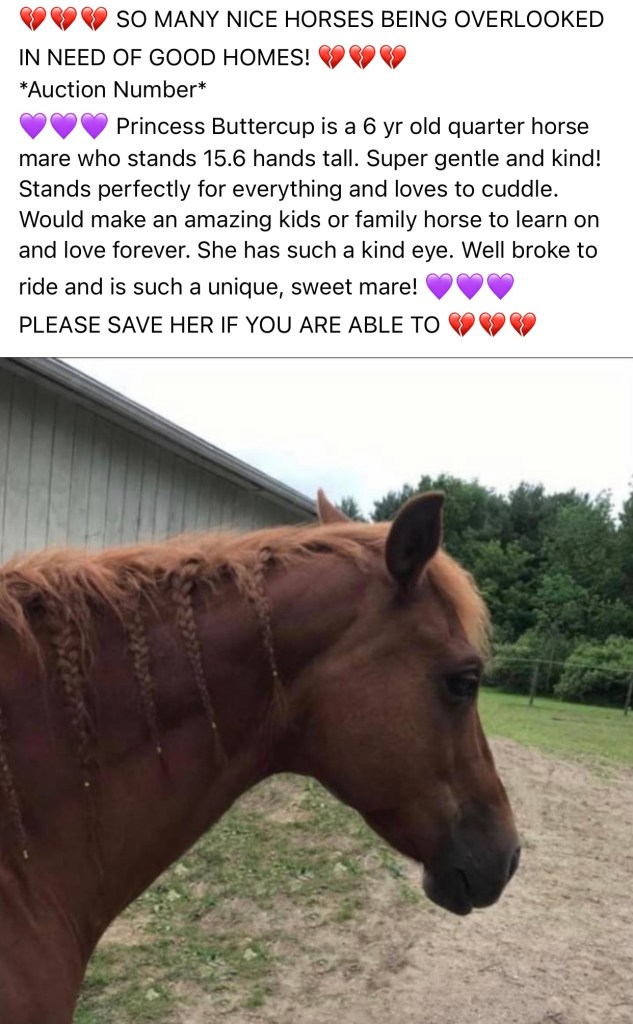
A few things I want you to notice in this ad are the obsessively positive descriptions of this horse and no (or very few) mentions of any negative traits or vices. Non-manipulative sale ads don’t look like this. First of all, the name Princess Buttercup screams “I’m adorable, please buy me for your child.” A lot of the horses posted always have cutesy or tacky names. There are some that might not, but that’s just for the purpose of adding variety to make sure people don’t catch on. 53 horses in a row with the name “Princess Buttercup” would be more than a little suspicious.
The heart emoticons and overly “lovey” descriptions sway you into feeling bad enough for the animal that you’re more willing to rescue it, regardless of the price. Not to mention, due to Facebook’s ban on animal sales, any and all posts with prices get taken down. This is where it gets even trickier, because once you go out of your way to message the page for the price list, they’re able to send you messages that may inflict guilt if you back out. The more you interact with these pages, the more they lay on the act that they want what’s best for the horses (but they don’t, they’re the ones sending them to slaughter in the first place).
This ad also has no mention of any real horse traits. Sure, they have the basics: age, breed, and height. However, they don’t include any tangible information about why the horse is perfect for families, why it’s considered a child’s horse, or what training it has (in detail). They don’t really go into detail about… well… anything. This is because the ad is fake and there’s no way for them to know any of these things, even if they were real. For comparison, look up some real horse sale ads and tell me how many of them don’t mention anything about whether the horse rides English or western. Real ads are full of information and details about all aspects of the horses’ lives, which is the exact opposite of what you’ll find in kill pen ads.
Every genuine person wants to provide the best life they can for their horse, which entails telling potential buyers all about their personality, quirks, training, and specific care needs. This is especially true for rescues, who work tirelessly to put together the perfect match between horse and owner. If it’s shortened into one brief, sappy paragraph, chances are good it’s not real.
Next, let’s analyze the photo. Kill pens often post close-up photos where the horses look more sweet and personable. Sometimes they even look slightly sad. Don’t be fooled, this is intentional. These photos are specifically chosen to elicit a response from the viewer. You can see my example photo of Chicken follows along these lines, even though she’s my healthy, well cared for, personal horse. Sure, the horses obviously aren’t jumping with joy to be in a kill pen, but their photos and unfortunate circumstances are so highly exaggerated that the only person it benefits is the “kill buyer”. The pages have learned that they get a larger outreach from the community if their photos match the emotional tone of the rest of the ad. If they were to show happy, alert horses, their sad and sappy captions wouldn’t make sense.
Overall, kill pen ads will have very noticeable overwhelming positivity about the horse, a never ending list of sappy stories, and a massive lack of detail overall. Remember, if it makes you feel a strong sense of sadness or guilt: you’re being manipulated.
Wait, wait, wait… But Isn’t Your Horse a Kill Pen Horse?
No.
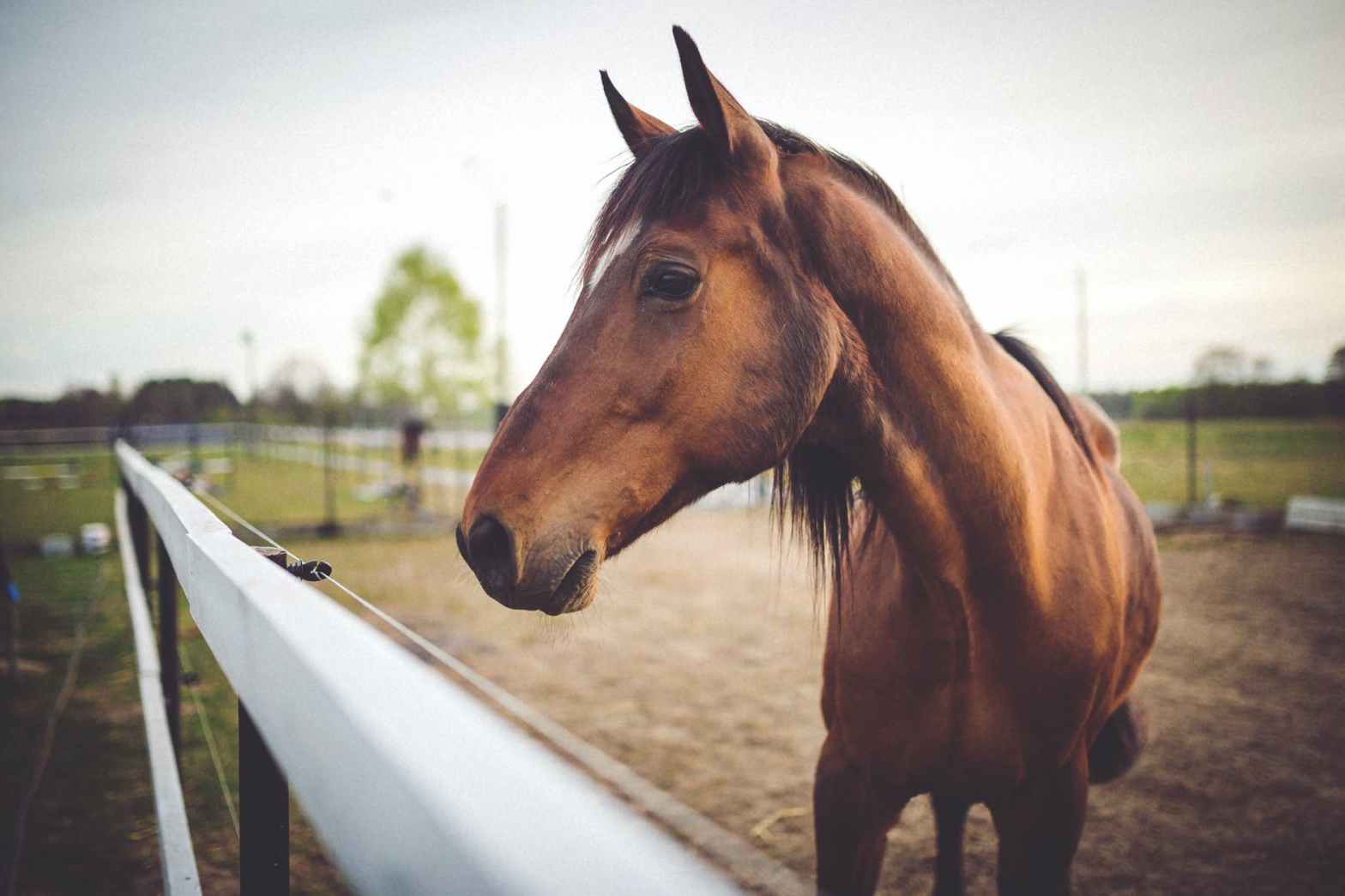
I rescued Chicken before she had a chance to get to a kill pen. She was never in the hands of a “kill buyer”. I made a deal with the previous owner and spared her from that path entirely.
However, this is not something I would recommend for everyone, which leads me to my next topic.
If Rescuing From Kill Pens Hurts Horses, How Can I Help?
There are many ways to help horses that don’t include being manipulated into funding the kill pens.
Support Your Favorite Rescue!
If you have a credible horse rescue local to you, you have a lot of different options! You can sign up to volunteer your time helping around the barn, drop off helpful/needed items, or even make monetary donations towards vet bills and other rescue expenses. If you have a specific skill or ability, you could even help them with more specialized needs, such as electrical work or basic construction. Local rescues are grateful for any help they can get, so don’t be afraid to speak up if you have unique ideas that could help them care for their animals. If you can’t find a local horse rescue, you can always search for a quality one online and make donations through their website. Not only will you actually be helping horses, but you won’t be putting any more in harms way.
Just make sure they don’t find their rescues through kill pens. Their good intentions might be to help horses, but there are still a lot of people who are deceived.
Rescue From Real Rescues
Even though kill pens are deceptive, there are still honest ways to rescue horses. Visiting and adopting from local, credible rescues not only insures that you’re actually helping horses as a whole, but also protects you from unforeseen circumstances and uncertainties. Rescues want to match the perfect horse and owner, which means they’re extremely unlikely to give you false information about the animal. You’ll have an accurate age, general behavior, and often times some amount of training. They will even have accurate medical records, since every horse receives a veterinary exam upon arrival to the rescue. Best of all, a lot of their horses come from owner relinquishes and abuse/neglect cases, so saving that one horse doesn’t automatically put others at risk.
Again, just make sure their horses don’t come from kill pens.
Don’t Participate in Kill Pen Rescue Fundraisers
Listen to me, I know you see that cute little face on their Facebook, and I know you want to send money to help save it. Don’t.
I know it’s hard, but “rescuing” that one will only lead to many more cute little faces ending up in the same position. Don’t share these posts, don’t send money to these posts, and definitely don’t help advertise these posts. By decreasing the attention that these posts get, you’re preventing more people from being manipulated by the same tactics and falling into the scam.
Spread The Word
One of the best and easiest things you can do to stop this deception is to educate your peers and acquaintances about it. Talk not only to the horse owners and riders in your life, but also to horse-loving friends and relatives as well. While it’s true they may not be actively rescuing horses in their free time, you never know who’s unknowingly donating to kill pen rescues and fundraisers behind closed doors.
When you do this, it’s likely that you’ll experience some disbelief and pushback. People have a hard time watching horses be sentenced to slaughter. I get it, I really do. But these “kill buyers” are merely pulling on their heartstrings and manipulating them. It’s not fair to the people who genuinely think they’re helping a good cause. They’re donating their hard earned money to what they think is rescuing a living creature, but not realizing that they’re accidentally supporting the slaughter industry that they’re so against.
If you don’t feel confident enough to have this conversation with them, you’re absolutely welcome to send them this post! There’s also thousands of other articles that cover this topic right at your fingertips (via the internet). Spread the word however you’re comfortable, as long as people are getting the message.
*If you’d like to read more about this topic, here are two links that I really recommend looking into:
- Click Here to read an article by a woman named Libery Valence, someone who used to personally buy from kill pens in the past. This is one of the most thorough explanations I’ve found so far and I especially like her easy-to-understand comparison of kill pens to puppy mills.
- Click Here to read an article written by a horse rescue organization – Equine Assist – detailing just how detrimental kill pens are to rescue efforts and how they’ve been affected in their mission personally.
I wish there were more organizations that have spoken out about this, but unfortunately a lot of the equine world is still being manipulated. Those that do know about this also may not have the platform to be able to publicly detail their thoughts. I’m hoping that by joining the efforts to expose this scam, more people will become aware of it.
The scam needs to stop, and you can help.
How Is This Going To Make a Difference?
I know what you’re thinking, “is avoiding kill pens really going to make a big enough difference?” The answer, in the long run, is yes.
If you haven’t figured it out by now, kill pens are a business. And what happens to businesses that don’t sell their inventory? They fail. It’s going to take a lot of learning and education to get there, but as soon as the public as a whole stops rescuing from and accidentally supporting the kill pens, their existence will dwindle off. If we, as educated members of the community, refuse to support their scam, they will eventually be forced out of the industry with very little funds to continue.
The more people “rescue” from kill pens, the more money they’re making and the larger and more prevalent the problem gets. That’s why it’s extremely important that we educate ourselves and those around us. By refusing to buy horses from the kill pens, less horses will be purchased from auctions by these people and fewer will have to go through the same situations.
Kill buyers want you to feel sorry for their animals. They want you to see that cute face, sweet personality, and rush to their rescue. If they didn’t, they surely wouldn’t allow their animals to become publicized and would make every effort to remain in seclusion. They’ve caught on to the fact that they can trick these well-meaning animal lovers into accidentally supporting them, and this is a major way that they’re making bigger profits. Kill pens are a scam, and the majority of the horse world is falling for it.
There are many ways to help rescue animals, but giving money to a kill buyer only sentences more of them to the same fate.
“There are two ways to be fooled. One is to believe what isn’t true; the other is to refuse to believe what is true.”
~ Soren Kierkegaard


Again Hayley, very well written and informative.
Sent from my iPad
>
LikeLike